
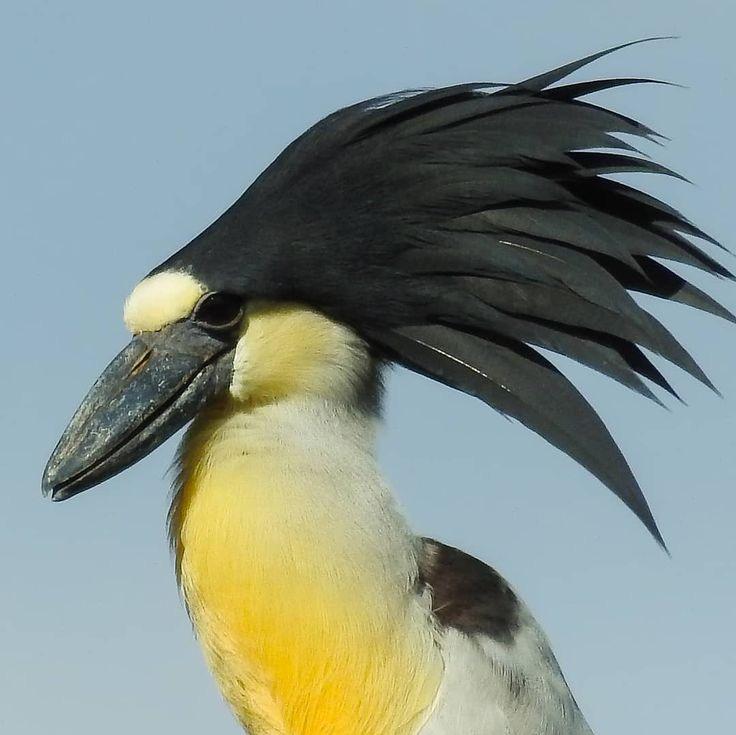
At night in the mangroves of Central and South America, a strange figure emerges: the Boat-billed Heron (Cochlearius cochlearius). With its unusually broad, scoop-shaped bill and long, slender neck, this nocturnal heron already looks otherworldly. But what truly sets it apart is its “hairdo” — a swept-back crest of feathers that gives it a dramatic, almost comical appearance, like a bird caught in a gust of wind.


Unlike its daytime relatives, the Boat-billed Heron is mostly active after dusk. By the dim light of the moon, it stalks quietly through mangroves, lagoons, and riverbanks. Its massive bill, resembling the prow of a boat, isn’t just for show: it’s a precision tool for scooping fish, insects, shrimp, and even small amphibians from the shallow water.
During breeding season, the display becomes even stranger. Males raise their crests, stretch their long necks, and produce a series of low, bizarre calls that echo eerily in the night — half croak, half growl. Together with their wild hairstyle, it creates a vision that feels part bird, part phantom.


Despite their odd looks, Boat-billed Herons are shy and secretive. They nest in colonies hidden deep in mangrove forests, building platform nests of sticks. By day, they remain motionless, blending into tangled roots and shadows, their elongated bodies making them almost invisible.
To birdwatchers, spotting one is unforgettable. The Boat-billed Heron is proof that evolution sometimes embraces the eccentric — combining a huge bill, a slender neck, and a wild feathered crown into a bird that looks like it belongs in a myth rather than a mangrove.