
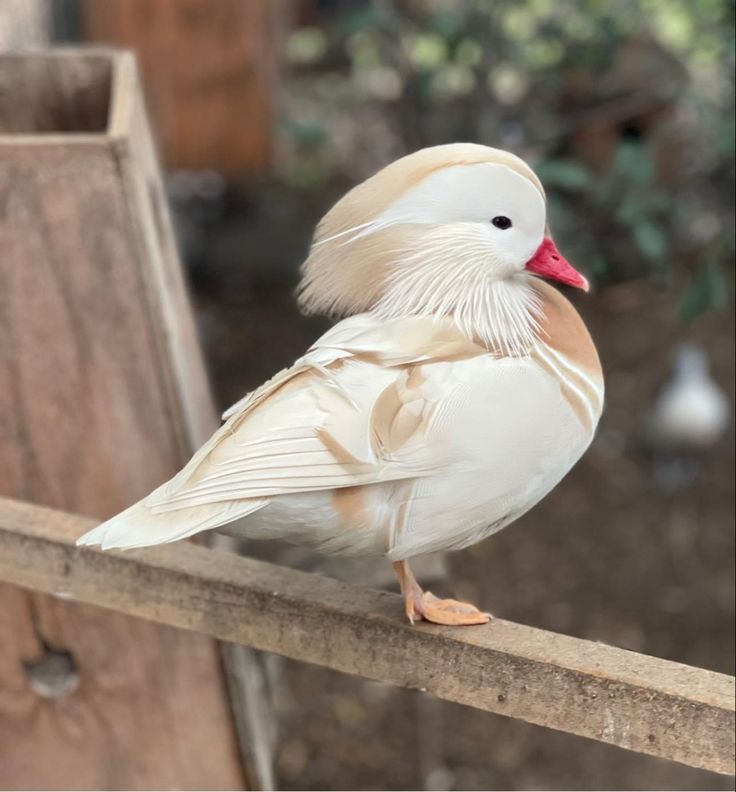
The Mandarin Duck (Aix galericulata) is already celebrated as one of the world’s most ornate and symbolic waterfowl. In its typical form, the male dazzles with flamboyant orange “sails,” a multicolored crest, and bold contrasts of blue, green, and chestnut. Yet on rare occasions, an unusual all-white form appears, transforming this already extraordinary species into something even more unique.
This white morph is not albino. Instead, it is caused by leucism — a genetic condition that prevents some pigments from developing in the feathers. Unlike albinos, leucistic ducks retain normal eye and bill coloration, which helps them avoid the vision and sensitivity issues associated with albinism. The result is a bird covered in immaculate white plumage, gleaming like porcelain, while still behaving and functioning exactly like any other Mandarin Duck.
Mandarin Ducks are native to East Asia, especially China, Korea, and Japan. They are cavity-nesting ducks, often laying their eggs in tree holes near rivers, ponds, and lakes. After hatching, the tiny ducklings leap from the nest to the ground or water below — a remarkable survival strategy shared with other perching ducks. Today, Mandarin Ducks also live in introduced populations in the United Kingdom, Germany, and the United States, where they have adapted well to parks and woodlands.
Culturally, they are revered as symbols of love and fidelity, often appearing in East Asian art and wedding traditions, since mated pairs are known to remain together throughout life.
The white leucistic form is extremely rare in the wild. Usually, only one or two individuals may appear in a large flock of normal-colored birds, making sightings highly prized by birdwatchers and photographers. Despite its unusual plumage, this morph behaves no differently — it feeds on seeds, aquatic plants, and small invertebrates, and migrates or breeds in sync with the rest of the population.


While the species as a whole is not considered globally threatened, Mandarin Ducks are still affected by habitat loss and wetland degradation in their native East Asian range. Protecting their natural breeding grounds ensures that even these rare genetic variants, like the White Mandarin Duck, continue to appear in the future.
For nature lovers, encountering one is a powerful reminder of how genetic variation adds to the richness of biodiversity — turning a familiar species into something strikingly new, yet deeply connected to its lineage.