
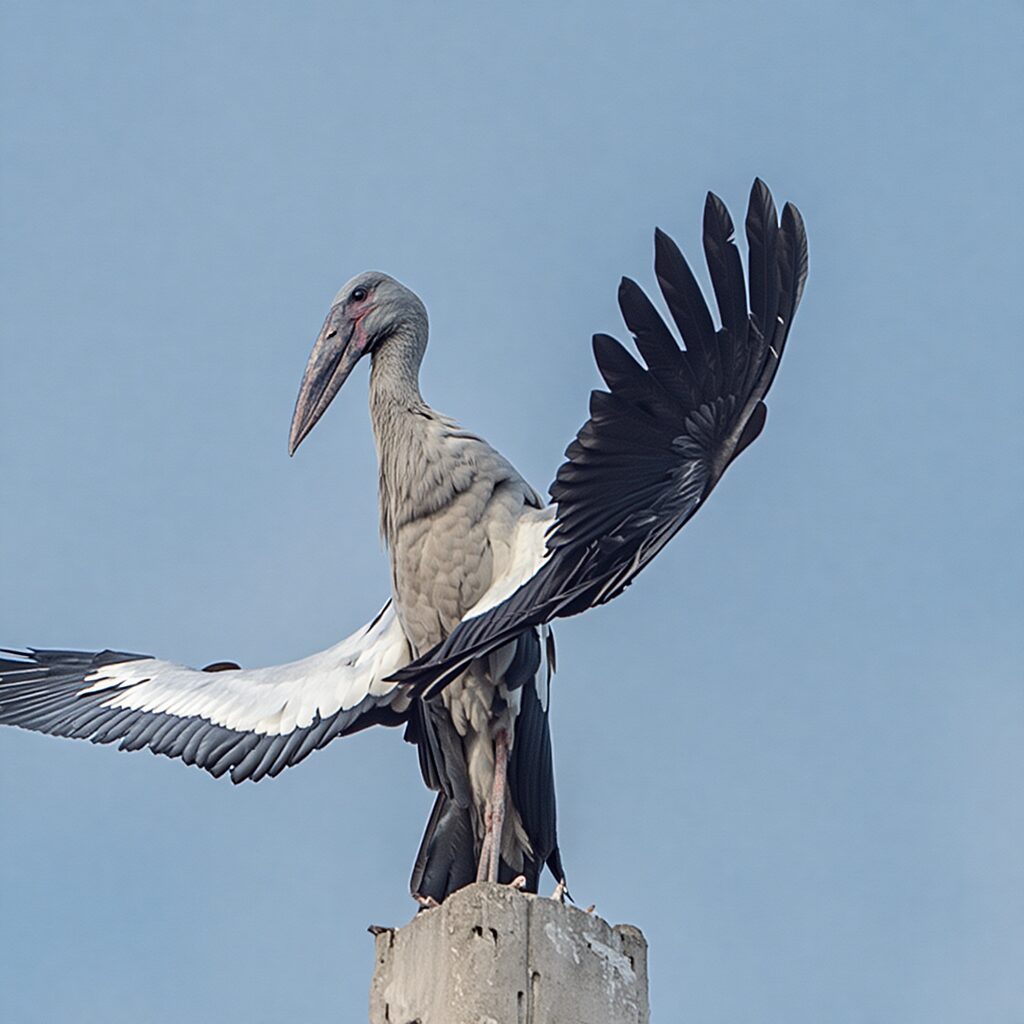
The Asian Openbill (Anastomus oscitans) is a stork commonly found across South and Southeast Asia, instantly recognizable by the gap between the upper and lower mandibles of its beak. This “open bill” is perfectly adapted for feeding on snails, especially apple snails, which make up the bulk of its diet.
Observers sometimes notice openbills standing motionless with their necks slightly bowed and wings folded, resembling a figure in prayer. While the posture looks spiritual, it is in fact typical stork behavior: conserving energy by standing still for long periods while waiting for prey or simply resting.
Like other storks, Asian Openbills also engage in “wing-spreading” and “sun-bathing” postures, which help regulate body temperature and kill parasites with UV light. Their apparent stillness is thus both a survival tool and a natural form of thermoregulation.
Despite being so widespread, the species plays an important ecological role — by controlling snail populations that can otherwise damage rice crops. This makes the “prayerful” stork an unintentional ally of farmers across Asia.