
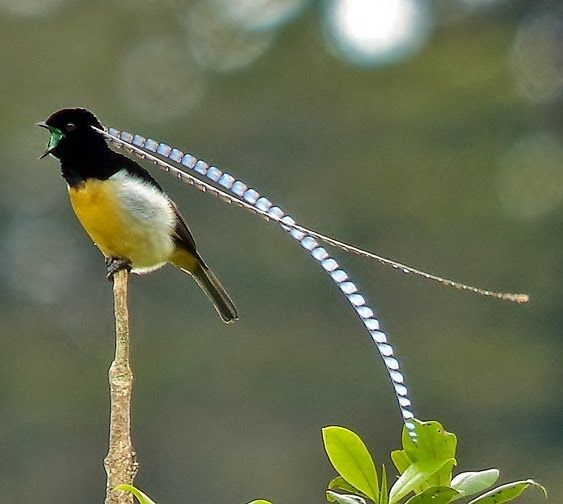
The Ribbon-tailed Astrapia (Astrapia mayeri) is one of the most spectacular members of the birds-of-paradise, found only in the highlands of Papua New Guinea. Males are instantly recognizable by their two extraordinary white tail streamers, which can reach up to three times the length of their body — the longest tail feathers relative to size of any bird on Earth.
These ribbons are not just for show — they’re central to the male’s elaborate courtship dances. In the forest canopy, he spreads his velvet-black body feathers, flashes his iridescent green and bronze throat, and waves his long tails in graceful arcs to impress nearby females. Every movement is choreographed to make the ribbons shimmer like flowing silk in the mountain light.


Females, in contrast, are modestly brown, well-camouflaged to protect their nests among mossy branches. Their choice of mate depends heavily on the male’s display quality and feather condition — a sign of strength, agility, and good genes.
Despite its stunning appearance, the Ribbon-tailed Astrapia lives in harsh alpine forests where temperatures can drop close to freezing. Yet it thrives, feeding on fruits, insects, and nectar among cloud-draped ridges.
Sadly, its beauty has made it a target for the feather trade and habitat loss, though protection efforts in Papua New Guinea’s highlands have helped stabilize populations.
Graceful, otherworldly, and utterly unique, the Ribbon-tailed Astrapia remains a living symbol of nature’s artistry — proof that even in the coldest mountain mists, beauty can take flight.