
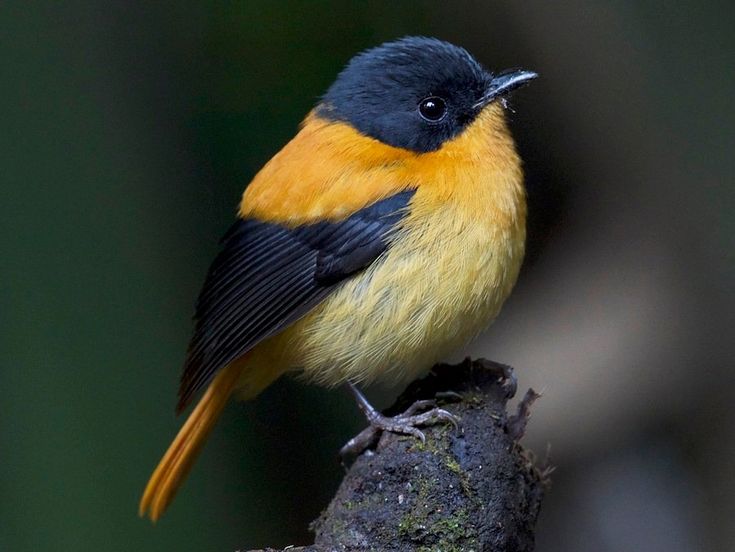
The Black-and-orange Flycatcher (Ficedula nigrorufa) is a small, striking songbird found only in the montane forests of southern India, particularly in the Western Ghats and Nilgiri Hills. Its bold contrast of fiery orange and velvety black makes it one of the most distinctive flycatchers in Asia — a living ember against the green forest understory.
Unlike many of its relatives that migrate, this species is strictly resident, staying within its cool, misty highland home all year round. It prefers dense, shaded undergrowth and mossy clearings, where it perches low and darts out to snatch insects in midair with quick, precise movements — the classic behavior of a true flycatcher.


Its diet includes beetles, flies, and caterpillars, often captured from perches close to the ground. The bird’s short tail and rounded wings make it agile in tight spaces, allowing it to maneuver easily among the foliage.
During the breeding season, the pair builds a neat, cup-shaped nest from moss, rootlets, and dry leaves, usually hidden in ferns or sloping banks. Both parents share incubation and feeding duties, demonstrating the strong pair bonds typical of flycatchers.
Because it lives only in limited highland habitats, the Black-and-orange Flycatcher is considered near-threatened, its survival tied closely to the preservation of the shola-grassland ecosystem of southern India.
Small but unforgettable, this bird is a quiet emblem of the Western Ghats — a reminder that even in a landscape of giants, the tiniest sparks can shine the brightest.