
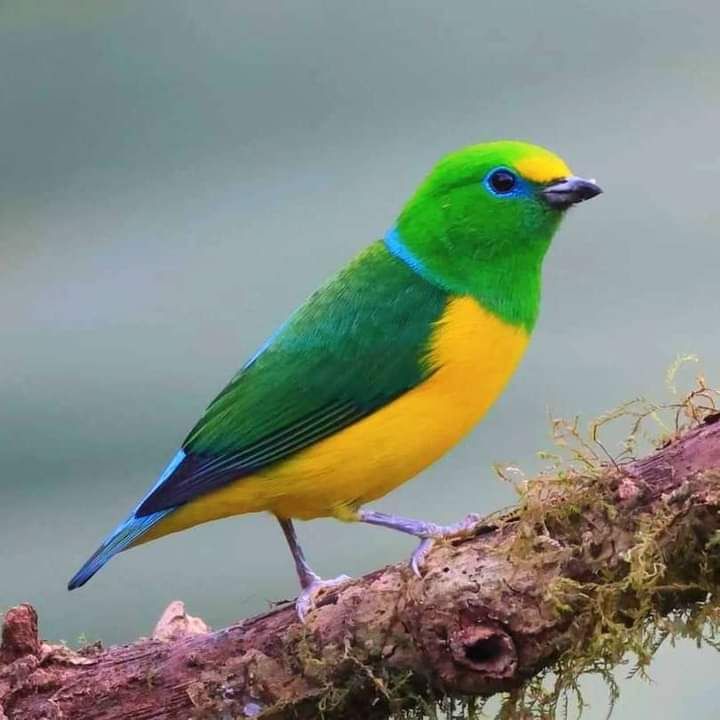
The Blue-naped Chlorophonia (Chlorophonia cyanea) is a small, frugivorous bird found across Central and South America, from Costa Rica to northern Argentina. It lives mainly in humid mountain forests and foothills, where fruiting trees are abundant.
A key fact about this species is its tight dietary specialization. Unlike many songbirds that mix insects and fruit, the Blue-naped Chlorophonia feeds almost exclusively on soft fruits and berries, particularly mistletoe (Loranthaceae). By swallowing the fruit whole and later excreting the sticky seeds, it plays a crucial ecological role as a seed disperser for these parasitic plants — helping maintain the balance of tropical forest canopies.


The species also exhibits altitudinal migration — moving up and down mountain slopes according to fruit availability rather than season or temperature. This behavior ensures it tracks food sources year-round, a survival strategy shared by few other Neotropical songbirds.
Though still widespread, the Blue-naped Chlorophonia is sensitive to deforestation and habitat fragmentation, as it depends on mature forests with fruiting trees. Its presence often signals a healthy, fruit-rich ecosystem — a quiet but vital thread in the tropical food web.