
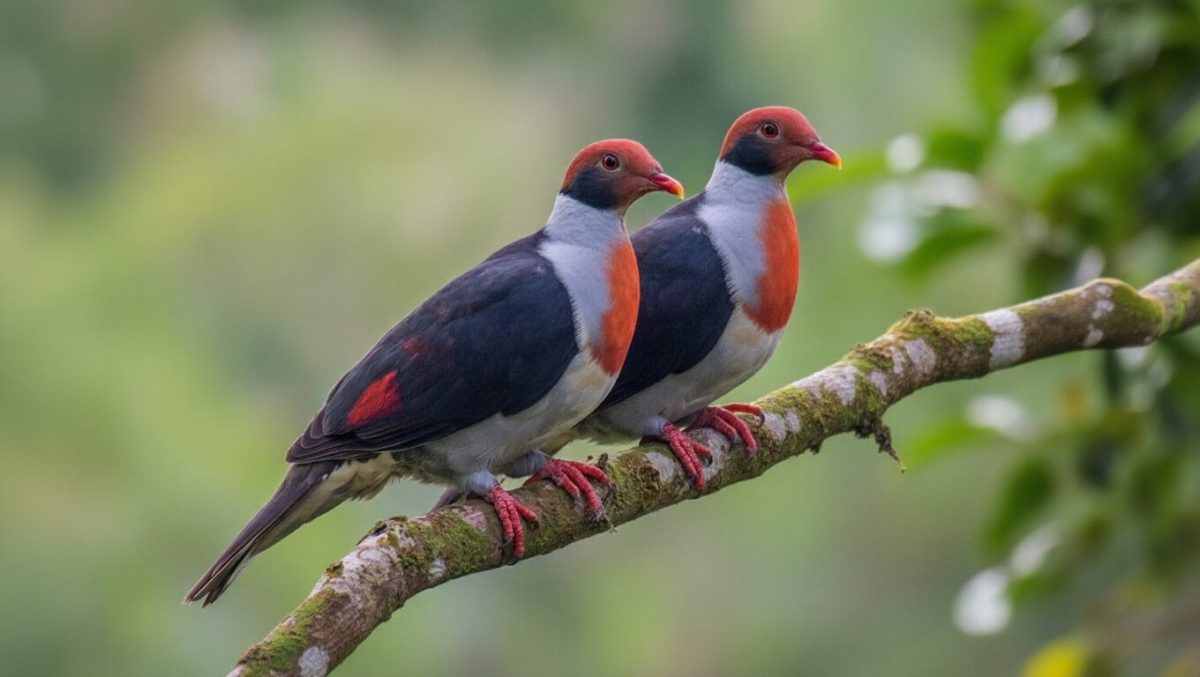
The Flame-breasted Fruit-Dove (Ptilinopus marchei) is one of the most striking and little-known pigeons of the Philippines — a forest jewel found only in the highland mossy forests of Luzon Island. Endemic and elusive, it lives among the mist-shrouded canopies of the Sierra Madre and Cordillera mountain ranges, where few humans ever venture.
At first glance, the bird looks as though it carries a spark of fire on its chest. The male’s plumage glows with a brilliant orange-red “flame” patch across its breast, sharply contrasting with emerald-green wings, a lilac-gray head, and a golden belly. The female, more subdued, trades brightness for camouflage, wearing softer greens and yellows that blend with the canopy foliage. Both sexes share the same rounded shape and gentle cooing call — a soft echo that often reveals their presence long before they are seen.


Like other members of the genus Ptilinopus, the Flame-breasted Fruit-Dove is a dedicated fruit specialist, feeding on figs and other small fruits. As it digests and disperses seeds through the forest, it plays a vital ecological role in maintaining the regeneration of the Philippine upland forests. Its movements between fruiting trees help connect fragmented habitats, quietly sustaining the very ecosystem it depends on.
But this dazzling bird teeters on the edge of survival. It is currently listed as Vulnerable by the IUCN, with an estimated population of only a few thousand individuals. The greatest threats come from deforestation, illegal logging, and land conversion in the highlands — pressures that have steadily erased much of its ancestral home. Hunting, though less common, still occurs in isolated regions.
To glimpse a Flame-breasted Fruit-Dove in the wild is to witness a rare miracle — a momentary flare of color in the cool green shadows of the mountains. It embodies both the beauty and fragility of the Philippine forests: brilliant, irreplaceable, and fading fast if the trees that shelter it fall silent.