
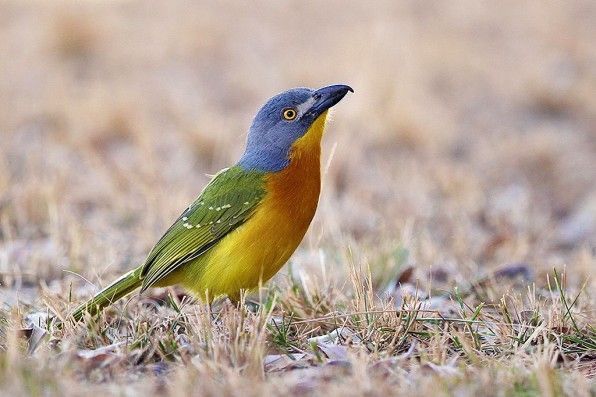
The Grey-headed Bushshrike (Malaconotus blanchoti) is one of Africa’s most secretive and fearsome songbirds. Despite its bright colors — olive back, yellow belly, and gray head — it is rarely seen, more often betrayed by its eerie, far-carrying calls that echo through the forest like a haunting whistle.
A key fact about this species is its predatory behavior. Unlike most songbirds, the Grey-headed Bushshrike is a powerful hunter, feeding on insects, reptiles, small birds, and even rodents. It often impales its prey on thorns or sharp twigs — a behavior shared with true shrikes, earning it the nickname “ghost of the bush.”


It belongs to the Malaconotidae family, a unique African group of bushshrikes related to vangas and helmetshrikes. Males and females look alike, and the bird is notoriously difficult to observe because of its solitary habits and preference for dense forest undergrowth.
Though widespread across sub-Saharan Africa, it is usually heard before it’s seen. Its low, repetitive call — described by field researchers as “haunting” or “melancholic” — is often the only sign that the silent hunter is nearby