
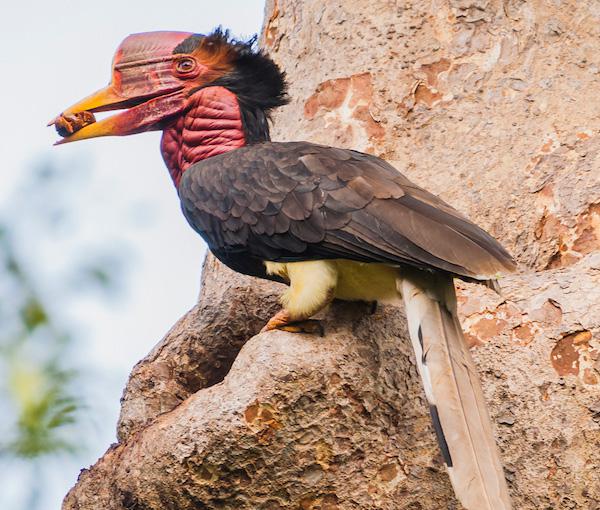
Deep in the rainforests of Southeast Asia lives one of nature’s strangest and most extraordinary birds — the Helmeted Hornbill. Its haunting, laughter-like calls echo through the canopy, but today those calls are fading fast.


What makes this bird so vulnerable is not just its beauty, but its biology. In southern Thailand, researchers have documented its unusual breeding ritual: when a female lays her egg, she seals herself inside a hollow tree cavity with mud and droppings, leaving only a narrow slit. From that moment, she and her chick rely entirely on the male to bring food until the chick is fully grown. If the male is killed by poachers, both mother and chick slowly starve. It is a reproductive gamble that evolution perfected — but humans have turned into a death sentence.

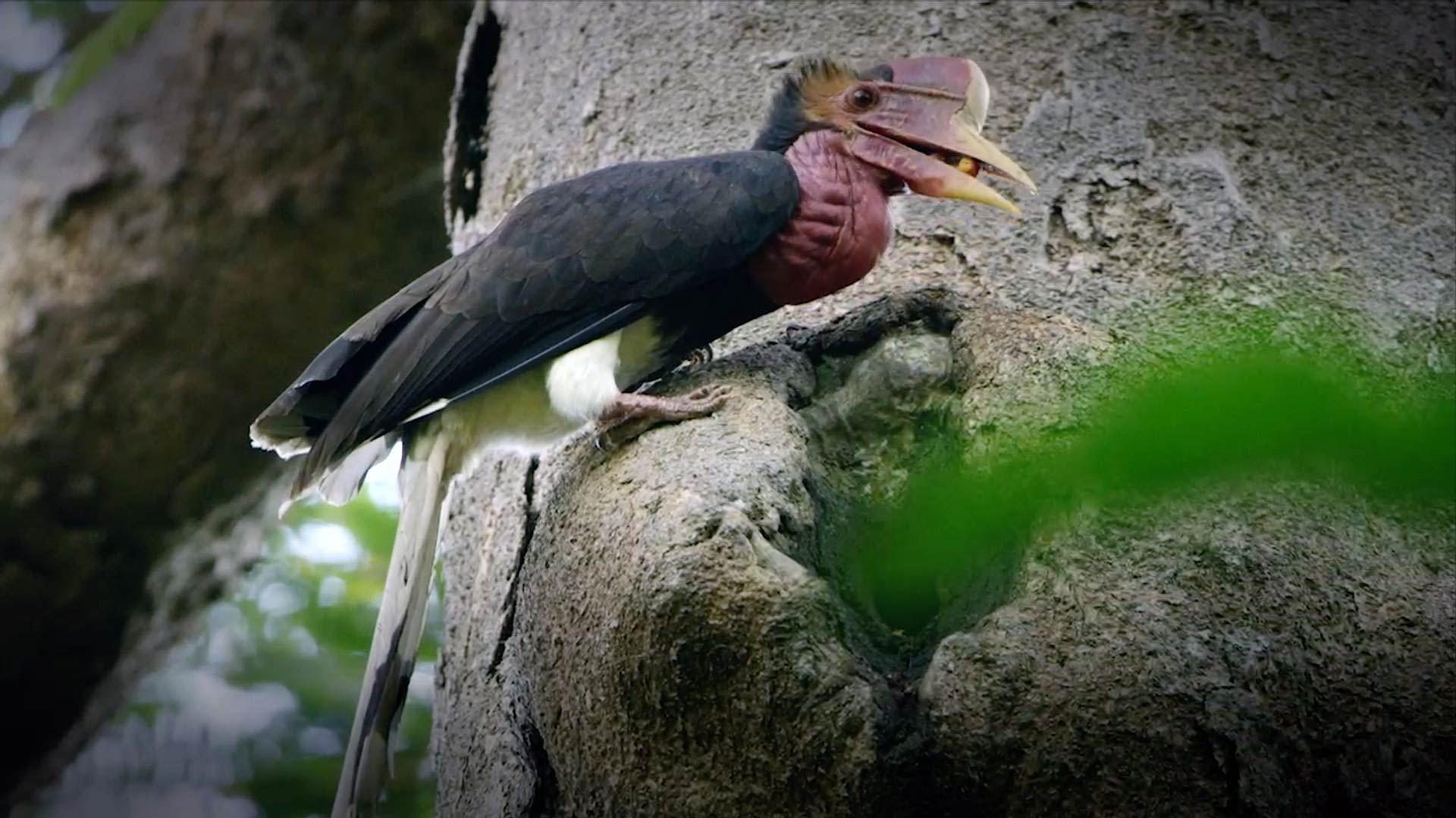
The threat comes from the bird’s unique casque, a solid block of keratin that makes up its massive forehead. Unlike the hollow casques of other hornbills, the Helmeted Hornbill’s is dense and carvable — earning it the name “red ivory.” Softer than elephant ivory, it became a prized material for intricate figurines and jewelry, fueling demand across luxury markets. Around 2012, that demand exploded. Since then, authorities have intercepted shipments of hundreds of casques, mostly in Indonesia and Thailand. Indonesian officials alone have seized over 1,300 casques, evidence of a thriving underground trade that rivals drug and arms trafficking.


Although international trade is banned under CITES, weak enforcement, light penalties, and corruption mean poaching continues. Conservation groups like TRAFFIC and the Environmental Investigation Agency argue that the laws are meaningless without boots on the ground — better training for rangers, stronger patrols in remote forests, and collaboration with local communities. At the same time, demand in consumer markets must be reduced through awareness campaigns and tighter restrictions on online sales.
Yet, amid the grim statistics, there is a spark of hope. Once ignored even by conservationists, the Helmeted Hornbill has now become a powerful symbol of the fight against illegal wildlife trade. Researchers like Yokyok Hadiprakarsa have pushed its story into the spotlight, showing the world how cultural desire, organized crime, and fragile ecosystems collide in one bird’s struggle.


The Helmeted Hornbill is more than just a victim. It is a messenger — reminding us that when greed meets silence, even the most remarkable creatures can vanish. But with global attention, protection, and resolve, its eerie laughter may yet continue to echo through Asia’s ancient forests.