
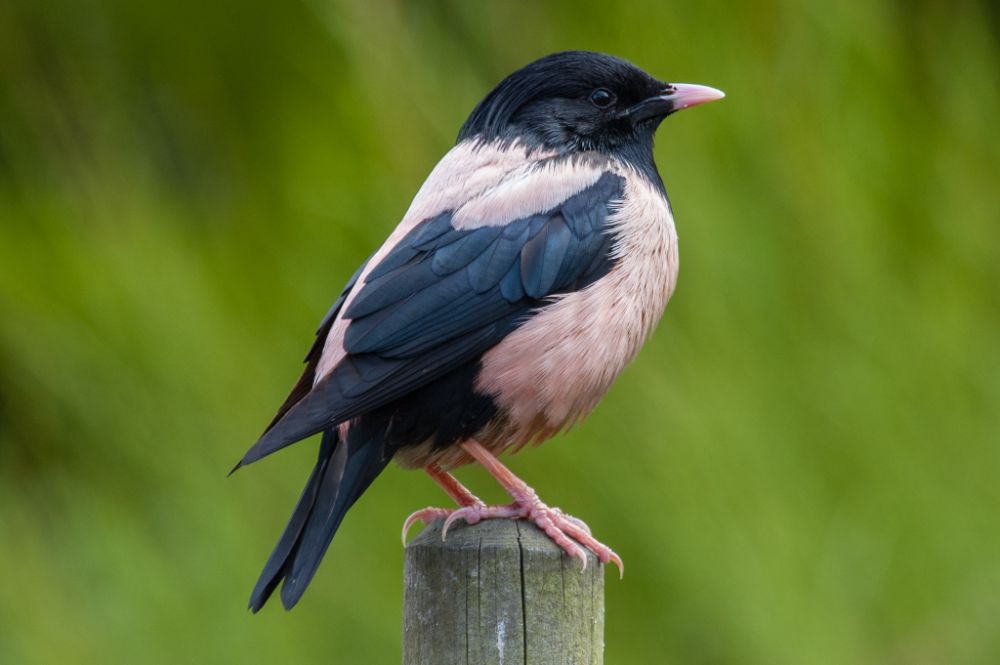
The Rosy Starling (Pastor roseus), also known as the Rose-coloured Starling, is a striking migratory songbird that transforms the summer steppes of Eastern Europe and Central Asia into a living mosaic of pink and black. Few birds embody such a sense of movement and spectacle — its life unfolds in vast flocks, shifting with the seasons like drifting petals in the wind.
In breeding plumage, adults are unmistakable: a rosy-pink body, glossy black head, wings, and tail, and a crest of sleek feathers that fans dramatically when excited. When thousands gather on cliffs or rooftops, their colors shimmer like ink and blush under the sun. In nonbreeding season, the plumage dulls, but their restless energy remains unchanged — always moving, always vocal.


The Rosy Starling’s story is one of epic migration. Each year, millions journey from their breeding colonies in the dry steppes and semi-deserts of Kazakhstan, Mongolia, and southern Russia to wintering grounds across India and Southeast Asia. Their arrival often coincides with outbreaks of locusts and grasshoppers — a fortunate match, as they feed voraciously on these insects, providing a natural form of pest control that farmers have long appreciated.
Breeding is a communal affair. The birds nest in dense colonies, filling cliffs, ruins, and rocky slopes with a ceaseless chorus of chatter and fluttering wings. Their synchronized movements, whether in flight or feeding, are mesmerizing to watch — a perfect display of unity and rhythm in nature. After breeding, entire colonies depart almost simultaneously, forming swirling clouds that darken the sky as they head south.
Despite their enormous numbers, Rosy Starlings face increasing challenges. Habitat changes, pesticide use, and shifting insect populations due to climate change all threaten to disrupt their delicate ecological timing. Fortunately, the species remains classified as Least Concern, sustained by its wide range and adaptability — but its dependence on healthy insect populations makes it a subtle barometer of ecosystem balance.
To witness a Rosy Starling flock is to see the wild pulse of migration itself — pink and black wings flashing in sunlight, the air alive with movement. They remind us that even the most beautiful travelers are tied to the fragile cycles of the earth they cross