
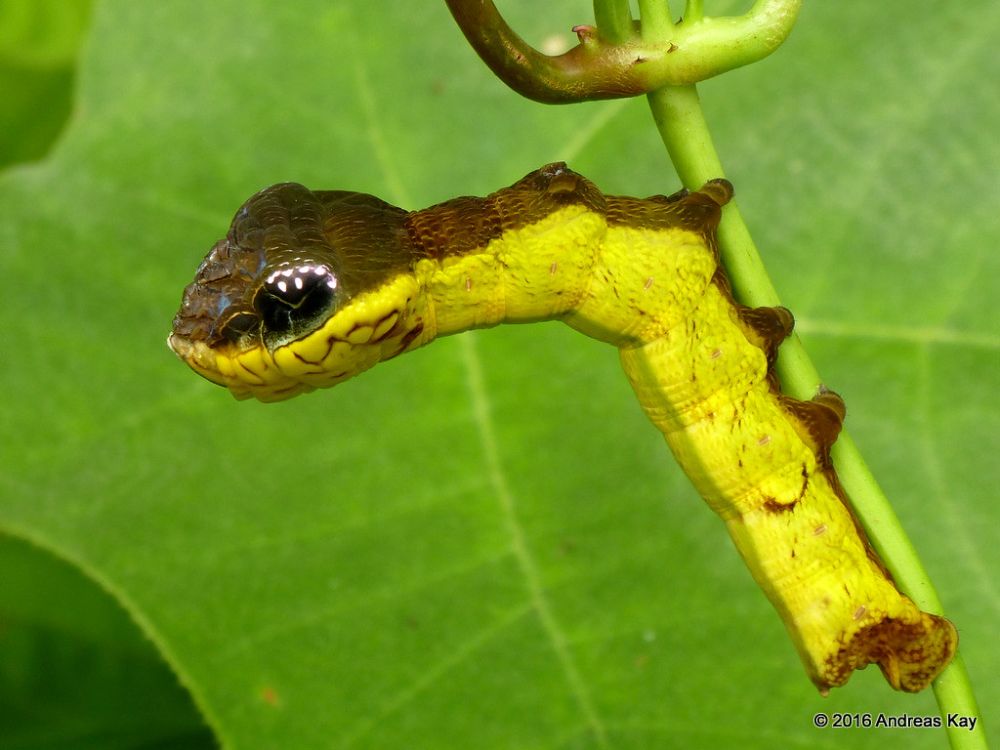
In the quiet undergrowth of fields and forests, the caterpillar of the sphinx moth hides a remarkable survival trick. When threatened by a bird or lizard, it suddenly transforms: its front body segments swell, its head retracts, and bold eye-like spots appear. The harmless larva now looks startlingly like a snake about to strike.
This dramatic bluff is an example of Batesian mimicry — where a harmless creature imitates the appearance of something dangerous. To a predator, even a moment of hesitation can mean the difference between life and death. Birds often recoil in alarm, giving the caterpillar a precious chance to slip away.
Up close, the illusion is astonishing. The “eyes” are not real, but pigment patches. The “strike pose” is nothing more than body posture. And yet, the mimicry is so convincing that even humans who stumble across one may flinch before realizing they are looking at an insect larva.
Of course, it is completely harmless. The caterpillar cannot bite, sting, or inject venom. Its only defense is deception — a temporary survival strategy during its vulnerable stage. All it needs is time: time to keep eating leaves, growing, and storing energy until the moment of transformation.


Eventually, the snake-like larva becomes a full-grown sphinx moth — a large, swift-flying insect with streamlined wings and a long proboscis perfectly designed for sipping nectar. Adults are powerful flyers, some capable of hovering like hummingbirds as they probe deep flowers. From a helpless caterpillar pretending to be a predator, it becomes a dazzling night-flyer, vital to pollination in many ecosystems.
The sphinx moth’s life story reminds us that nature’s most effective weapons are not always claws or venom — sometimes, survival depends on the power of illusion.