
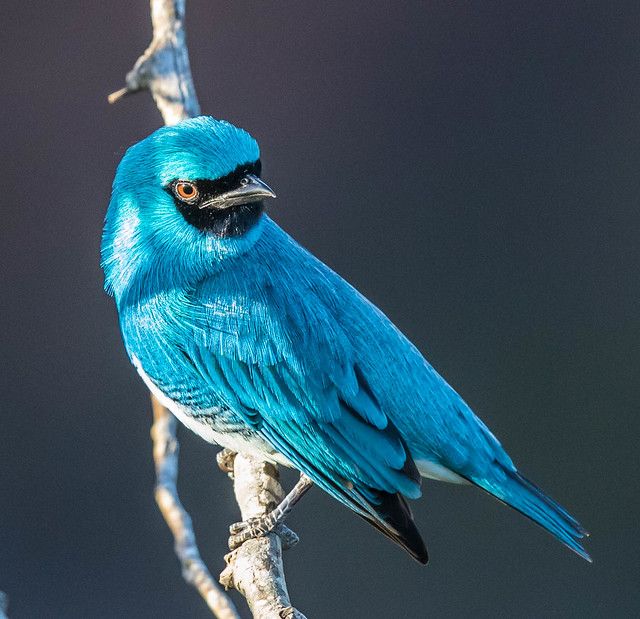
The Swallow Tanager (Tersina viridis) is one of South America’s most eye-catching birds, found from Panama to northern Argentina. At first glance, the male looks like it was dipped in turquoise paint — shimmering blue-green above with a neat black mask and white underparts. But here’s the twist: that dazzling color isn’t from pigment at all. It’s created by microscopic structures in the feathers that scatter light, a phenomenon called structural coloration.
Females and young males are olive-green, blending perfectly with foliage — a smart camouflage for nesting and feeding. These tanagers are named for their swallow-like shape and flight style, often seen gliding gracefully across forest clearings and river edges.


Swallow Tanagers are fruit and insect eaters, playing a key role in seed dispersal. During breeding season, they excavate nests in earthen banks or termite mounds — an unusual choice among tanagers — and both parents share incubation duties.
Despite their bright looks, they are quiet and gentle birds, often joining mixed-species flocks in the canopy. Their beauty is best appreciated in sunlight, where the angle of light transforms their feathers from blue to green to turquoise in a living display of optical magic.