
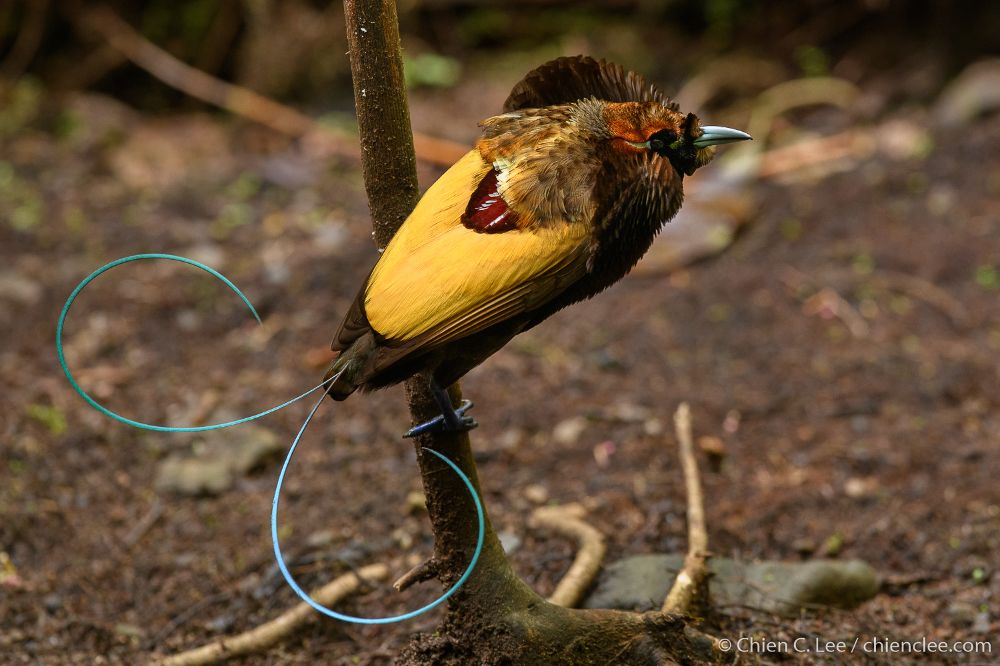
The Magnificent Bird-of-Paradise (Cicinnurus magnificus) is one of the most mesmerizing creatures of New Guinea’s mountain forests — a bird that seems designed entirely for performance. Males are small, barely 16 cm long, yet their beauty is breathtaking: emerald-green breast shield, golden-yellow cape, crimson back, and two curling blue tail wires that shimmer like neon light in the forest gloom.
When it’s time to court, the male clears a display court on the forest floor, sweeping away leaves to create a clean stage. Then he begins his show. Standing before the female, he spreads his cape and breast feathers into a brilliant oval disc of color, transforms into a glowing orb, and hops in rhythm — side to side, bowing and calling softly. The performance can last for minutes, with every move rehearsed to perfection.


Females, dull brown and cautious, watch from above before choosing the most skilled and vibrant dancer. Once she mates, she leaves to build a nest alone — a hallmark of many birds-of-paradise, where male beauty exists purely for display.
The species inhabits montane rainforests from 1,200 to 1,800 meters, feeding on fruits, insects, and small arthropods. Its colors are not from pigment but structural iridescence, where microscopic feather layers bend light into shifting hues — a masterpiece of natural physics.
To see the Magnificent Bird-of-Paradise dance is to watch evolution at its most theatrical — a living jewel performing beneath the emerald canopy, proving that in the wild, beauty itself can be a form of survival.