
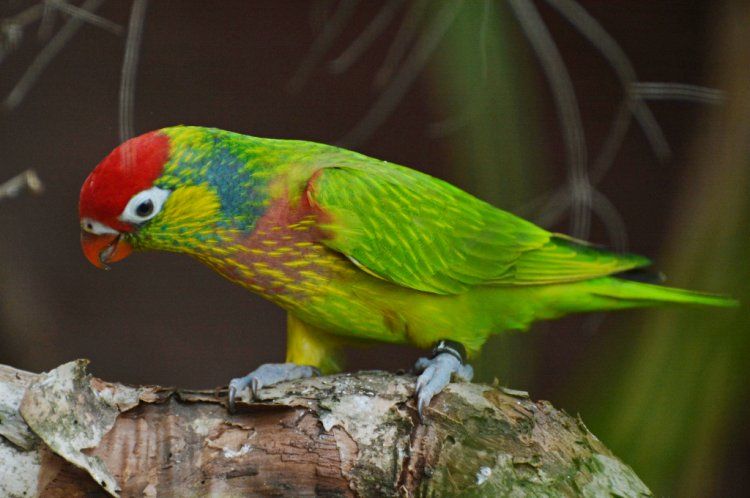
The Varied Lorikeet (Psitteuteles versicolor) is one of Australia’s most vibrant small parrots, a flash of red, green, yellow, and violet that darts through the dry woodlands of the north. Despite its dazzling plumage, it’s often overlooked — partly because it lives in remote regions and blends perfectly with the blossoms it feeds on.
This lorikeet thrives in arid and semi-arid habitats, following the flowering of eucalyptus and paperbark trees across northern Australia. Its diet is almost entirely nectar and pollen, which it collects using a specialized brush-tipped tongue covered in fine hairs. While feeding, it becomes dusted in yellow pollen, sometimes glowing golden under sunlight.


The Varied Lorikeet is a fast, restless, and highly social flier, often forming noisy flocks that descend on flowering trees in waves of color and sound. Their calls are sharp and metallic, echoing across open savannas. Pairs form strong lifelong bonds, nesting in hollows of old trees, where the female lays two to four eggs while the male guards the site.
During hot days, they gather at waterholes to drink and bathe — a rare and beautiful sight, with dozens of lorikeets shimmering like gems against the red dust. Though locally common, their dependence on native flowering trees makes them vulnerable to habitat clearing and drought.
Small yet striking, the Varied Lorikeet embodies the energy of Australia’s interior — a tiny desert wanderer powered by sunlight and flowers, surviving where few other parrots dare to live.