
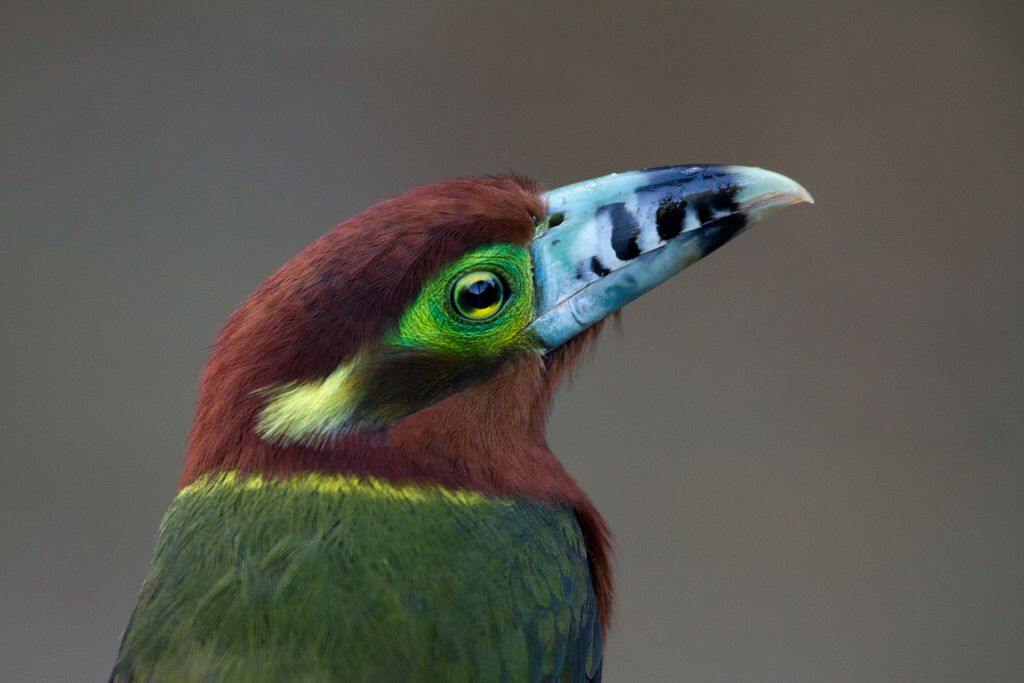
The Spot-billed Toucanet (Selenidera maculirostris) is a small toucan species native to the Atlantic Forests of Brazil, Paraguay, and Argentina. Unlike its larger, more vocal relatives such as the Toco Toucan, this bird lives a secretive life in the shaded mid-canopy, rarely seen despite its vivid markings.
Its name comes from the distinct pale spots on its dark bill, a feature that helps researchers distinguish it from other toucanets. Males and females look markedly different — one of the few toucan species showing strong sexual dimorphism. Males have black heads and bright yellow cheeks, while females display chestnut tones, an adaptation possibly linked to nesting camouflage.


Spot-billed Toucanets are fruit specialists but also feed on insects and small vertebrates, playing a critical role as seed dispersers within the rapidly shrinking Atlantic Forest. Their digestive systems are adapted to pass seeds intact, allowing plants to regenerate across fragmented forest patches.
Interestingly, their vocal behavior is unusually subdued for a toucan. They communicate using low croaks and clicks instead of the typical echoing calls, which may help them stay unnoticed by predators in dense forest layers.
Now threatened by deforestation, the Spot-billed Toucanet stands as a symbol of the Atlantic Forest’s fragile biodiversity — a quiet guardian of one of the world’s most endangered ecosystems.