
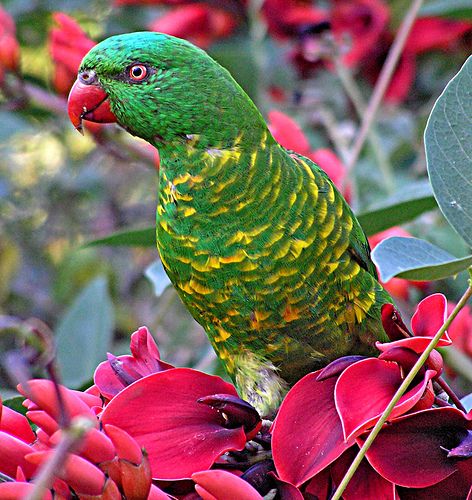
The Scaly-breasted Lorikeet (Trichoglossus chlorolepidotus) may not be as brightly colored as its rainbow relatives, but a closer look reveals its own stunning detail — a chest covered in fine yellow-edged feathers that resemble tiny scales, giving it the look of a bird wearing natural armor. Native to eastern Australia, it inhabits open woodlands, coastal forests, and city parks, often traveling in lively, noisy flocks.
This species is a nectar specialist, feeding on the sweet liquid from eucalyptus blossoms and native shrubs. Its tongue is tipped with brush-like papillae — microscopic bristles that act like a sponge, soaking up nectar and pollen. It also eats soft fruits and occasionally insects, making it an important pollinator for many flowering plants.


Scaly-breasted Lorikeets are extremely social and active, constantly chattering in flight with high-pitched screeches. During the breeding season, pairs nest in hollows of old gum trees, lining them with wood dust. Both parents share incubation and feeding duties, showing strong pair bonds typical of lorikeets.
Despite their cheerful appearance, they are highly territorial, often chasing away other birds — even larger ones — from their feeding spots. Their agility and intelligence make them successful urban survivors, commonly seen darting through suburban gardens.
With their bright green plumage blending into foliage and their scaled breast flashing golden in sunlight, the Scaly-breasted Lorikeet is a perfect example of Australia’s hidden brilliance — small, tough, and endlessly energetic, thriving amid the hum of life along the continent’s east coast.