
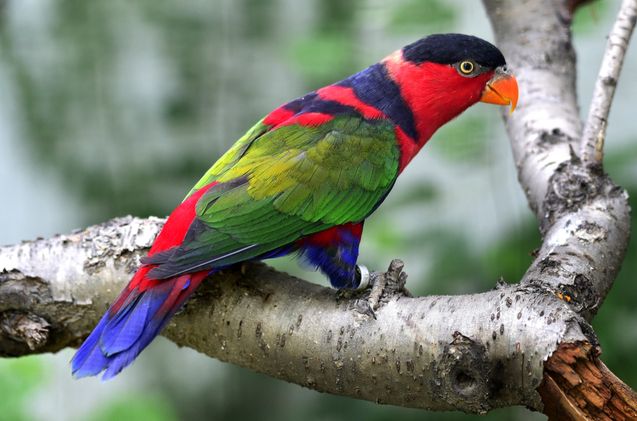
The Black-capped Lory (Lorius lory) is one of the most vividly colored parrots on Earth — a living mosaic of scarlet, indigo, orange, and emerald, crowned with a distinctive black “cap” that gives the species its name. Native to New Guinea and nearby islands, it inhabits humid forests, mangroves, and coconut groves from sea level up to the misty foothills.
Unlike many parrots, the Black-capped Lory is strongly frugivorous and nectarivorous, feeding on fruit, pollen, and nectar that it gathers with its brush-tipped tongue. It plays a crucial ecological role as a pollinator for numerous tropical trees and shrubs. Its flight is swift and direct, and its loud, ringing calls often reveal its presence long before it’s seen — a bright streak of red and blue cutting through the green canopy.


Pairs are highly affectionate and lifelong, often seen perching close together, preening one another, and softly chattering. They nest in tree cavities, laying two to three eggs that both parents incubate and protect fiercely. Juveniles can be told apart by their darker plumage and brown bills, which gradually turn orange as they mature.
There are several regional subspecies, each with slight variations in color pattern — some with blue bellies, others with green shoulders — but all share the same bold beauty and intelligence characteristic of the genus Lorius.
Sadly, the Black-capped Lory faces pressure from habitat loss and the illegal pet trade, as its striking plumage makes it a frequent target. Yet in the wild, among New Guinea’s rainforest blossoms, it remains a symbol of tropical brilliance — a bird that carries the jungle’s full palette on its wings.