
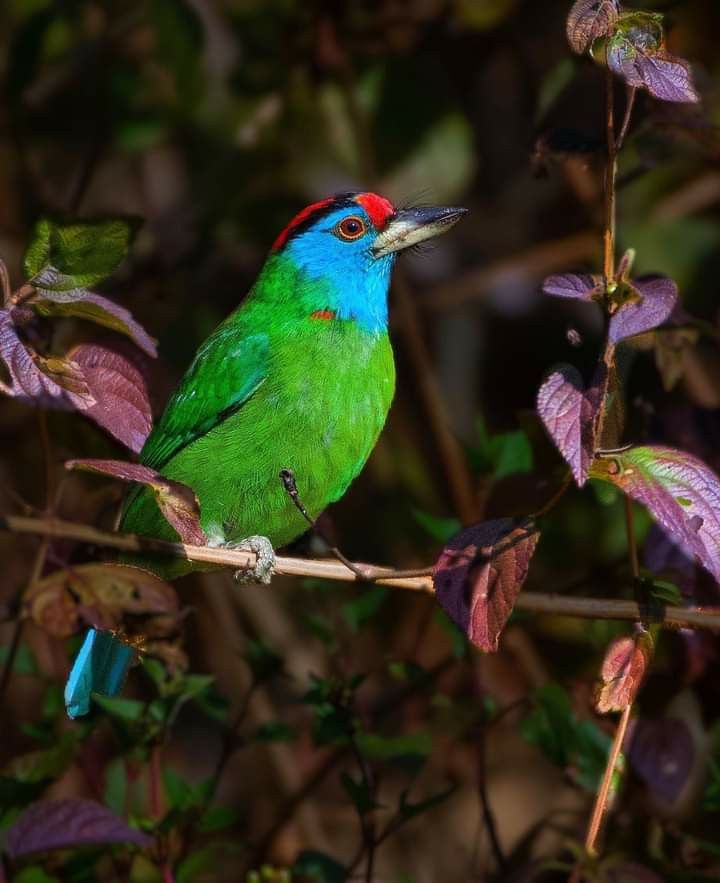
The Blue-throated Barbet (Psilopogon asiaticus) is one of the most vividly colored birds in South and Southeast Asia, a living mosaic of emerald green, turquoise blue, crimson red, and lemon yellow. Found from the Himalayas to Vietnam, it thrives in forests, gardens, and fruit orchards — wherever trees bear ripe figs and berries.
Its name comes from the brilliant turquoise-blue patch on its throat and face, which gleams like a gemstone in sunlight. Despite its bright appearance, the bird is often hard to spot, as it sits motionless among leaves, giving away its presence only by its sound — a loud, repetitive “tuk-tuk-tuk” call that echoes through the forest canopy.
Like other barbets, it has a heavy, ridged bill used to chisel into fruit and tree bark. It also excavates nest holes in dead wood, where both parents share incubation and chick-rearing duties. Their diet of fruits and insects makes them important seed dispersers, helping maintain healthy forest ecosystems.
The Blue-throated Barbet’s plumage serves not only as camouflage among tropical leaves but also as a signal of health and vigor during breeding. Males with the brightest colors are often the most successful in attracting mates.
Brilliant yet elusive, noisy yet secretive — the Blue-throated Barbet embodies the vibrant paradox of Asia’s forests, a flash of color that turns every treetop into a living canvas