

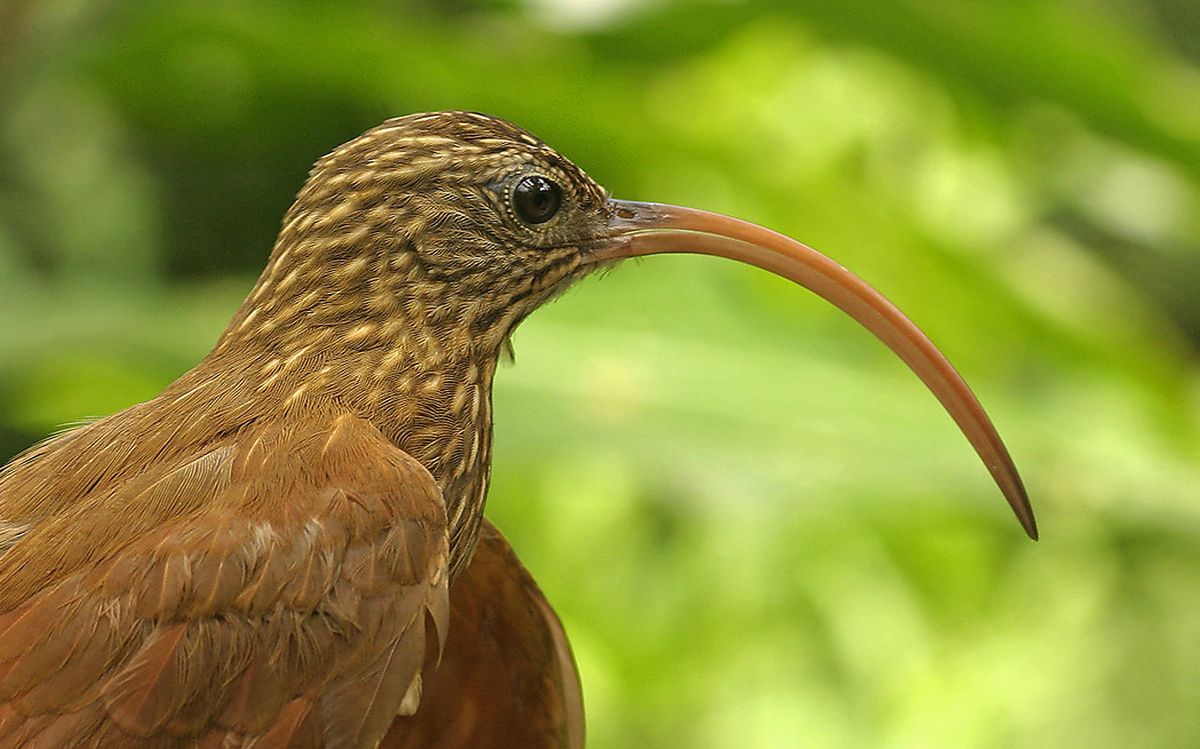
The Curve-billed Scythebill (Campylorhamphus procurvoides) is one of the Amazon’s most specialized and mysterious forest birds. Its defining feature — a long, slender, and dramatically curved bill — looks almost like a surgeon’s tool or a blacksmith’s scythe. But this unusual shape has a clear purpose: it allows the bird to probe deep into tree bark, crevices, and bromeliads in search of hidden insects and spiders that other birds can’t reach.
Belonging to the woodcreeper family, the Scythebill moves much like a miniature woodpecker — climbing tree trunks vertically, bracing itself with stiff tail feathers while inspecting bark layer by layer. Unlike woodpeckers, however, it doesn’t drill; instead, it relies on stealth and precision to extract prey.


Its reddish-brown plumage, streaked with buff and chestnut, blends perfectly with the rainforest’s dappled light, making it nearly invisible as it moves silently among moss-covered trees. The bird’s eerie, fluting call is often the only sign of its presence in the dense canopy.
There are several subspecies across South America, each adapted to different forest types — from humid lowlands to cloud-covered mountains. This makes the Curve-billed Scythebill a prime example of adaptive evolution within the Amazon’s labyrinthine ecosystems.
With its delicate craftsmanship and quiet grace, the Curve-billed Scythebill embodies the rainforest’s secretive ingenuity — a creature shaped perfectly by the hidden world it calls home.