
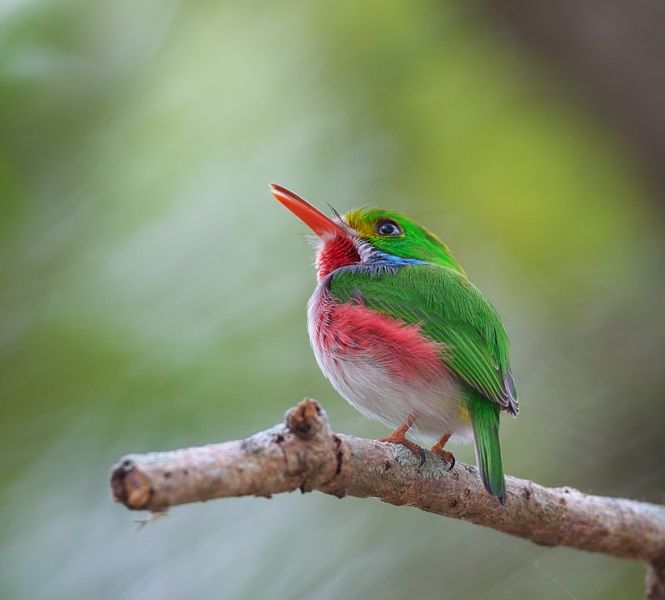
The Cuban Tody (Todus multicolor) is one of the smallest and most dazzling birds in the Caribbean, found only on the island of Cuba. Barely 11 cm long, it glows with emerald-green upperparts, a crimson throat, pink flanks, and a sapphire-blue line along its side — a living gemstone perched in the tropical forest.
Despite its delicate look, the Cuban Tody is a fierce and active hunter, darting swiftly through dense vegetation to catch insects, spiders, and small lizards. Its short wings and rapid wingbeats make a soft “whirring” sound as it moves — one of its charming signatures in the forest.


Like other todies, it has a broad, flattened bill that snaps shut with incredible speed, perfectly adapted for ambushing flying insects. Its eyes are large and expressive, giving it a curious, almost toy-like appearance.
During breeding season, both male and female excavate a nest tunnel in an earthen bank or rotten stump, sometimes up to 30 cm deep, leading to a small chamber lined with soft plant fibers. They fiercely guard their nest and feed their chicks a constant supply of insects.
The Cuban Tody is more than a bird — it’s an icon of the island’s biodiversity, representing evolution in isolation. With its brilliant colors, gentle “tot-tot” call, and tiny size, it remains one of the Caribbean’s most beloved natural treasures — proof that even the smallest creatures can carry the brightest beauty.