
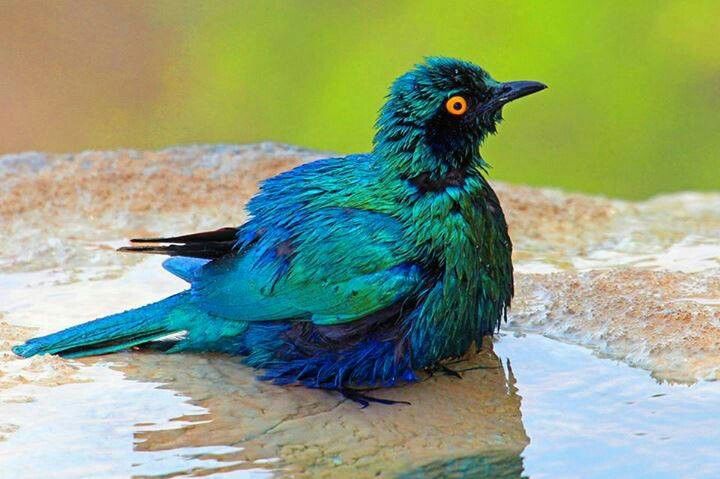
At first glance, the Greater Blue-eared Starling (Lamprotornis chalybaeus) looks less like a bird and more like a living jewel. Its feathers gleam with shimmering turquoise, deep blue, and violet tones, as though dipped in molten chrome.


But here’s the secret: those dazzling colors aren’t from pigment at all. Instead, they’re the result of structural iridescence — light scattering through microscopic layers in the feathers, producing that shifting metallic glow every time the bird moves.
Native to sub-Saharan Africa, these starlings are social creatures, often gathering in noisy flocks. When they fly together, their bodies flash like moving shards of polished metal against the sky. Their bright yellow eyes add an extra intensity, giving them a piercing, almost otherworldly stare.


Highly adaptable, they feed on insects, fruit, and even scraps around villages, thriving in both wild savannas and urban landscapes. And though they may be common in Africa, their glittering appearance never fails to leave a lasting impression — a reminder that sometimes, nature doesn’t just imitate art, it outshines it.