
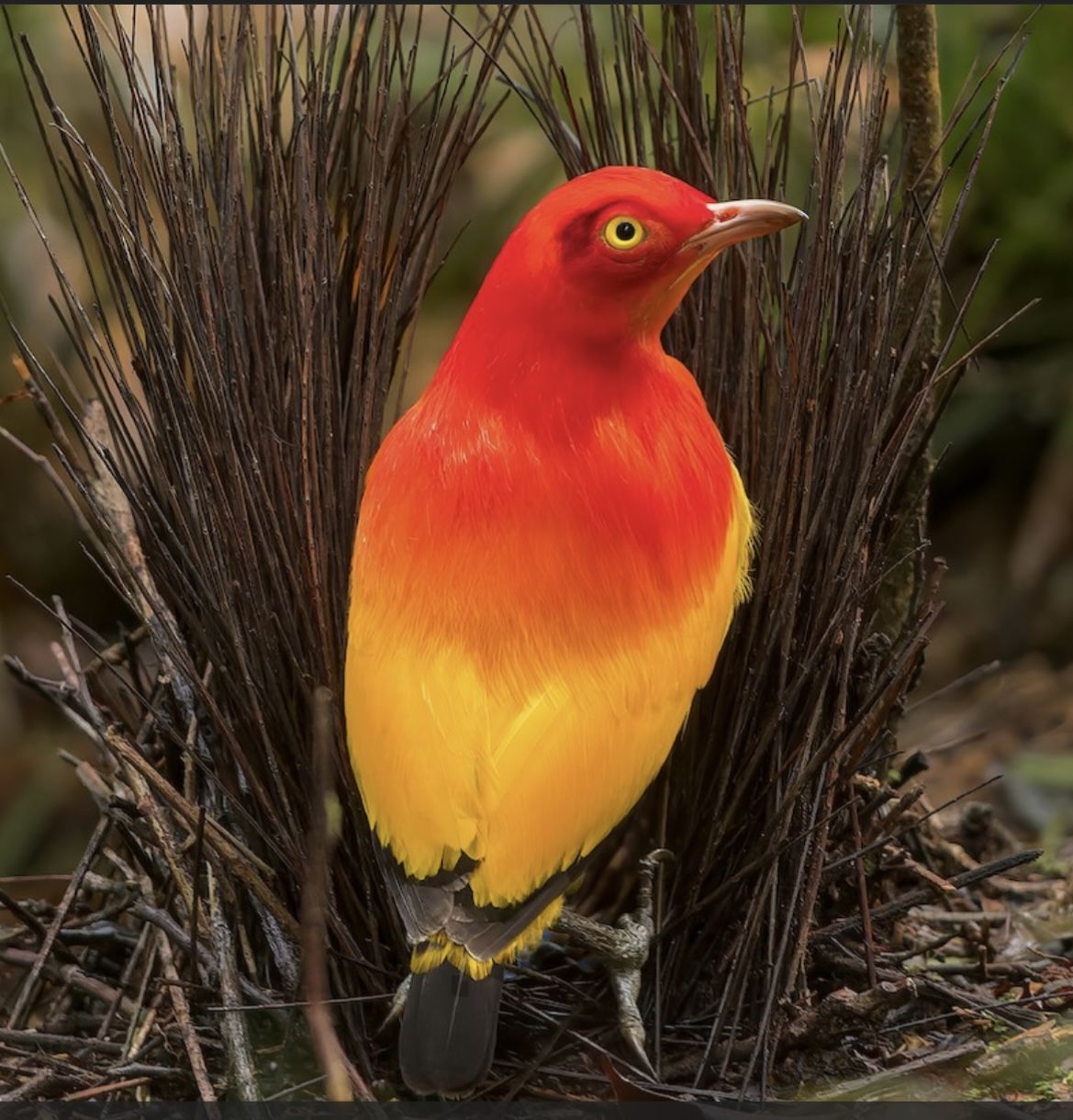
The Flame Bowerbird (Sericulus aureus) is one of nature’s most spectacular architects — a bird whose courtship depends not on song, but on art. Endemic to the lowland rainforests of New Guinea, the male glows with brilliant scarlet and orange plumage, like a living ember moving through the green shadows. But his true masterpiece lies on the forest floor: the bower, an intricate display arena built to win a mate.
Unlike a nest, which is used to raise chicks, the bower is purely a stage for performance. The male constructs a neat avenue-type structure from twigs, about 50 cm long, carefully aligned and cleared of debris. Around it, he decorates the ground with brightly colored objects — berries, flowers, leaves, even beetle shells — favoring hues that complement his fiery feathers. Every item is placed deliberately to catch the female’s eye.


When a potential mate approaches, the male performs an intense courtship dance, spreading his wings and bowing repeatedly, his plumage flashing like flame against the dark forest. The female inspects both his dance and the perfection of his bower before deciding to mate.
Afterward, she alone builds a simple, hidden nest of leaves and grass in a nearby tree, where she lays and raises her chicks — the bower’s purpose completed.
To see a Flame Bowerbird at work is to witness evolution as art — a creature turning light, color, and motion into one of the world’s most beautiful love displays.