
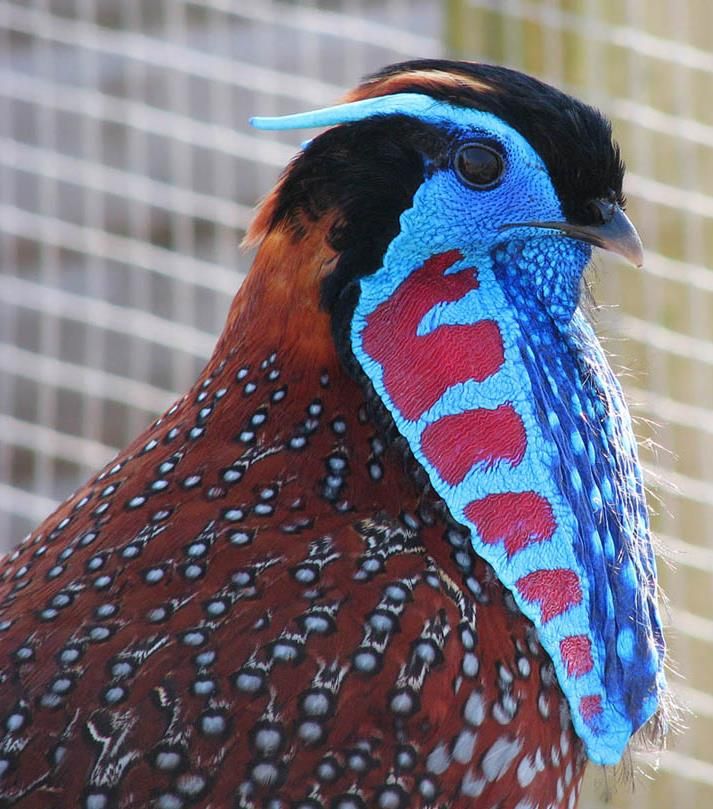
The Temminck’s Tragopan (Tragopan temminckii) is one of the most dazzling pheasants of the Himalayas and mountain forests of Southeast Asia. Males are instantly recognizable by their bright crimson plumage, white-spotted body, and striking blue facial skin, which contrasts like a living flame against the green forest.
During courtship, the male performs one of the most spectacular displays in the pheasant world. He lowers his wings, fans out his tail, and inflates vivid blue lappets and a horn-like wattle that extend from his head, creating an otherworldly mask to impress females.
In contrast, females are well-camouflaged in brown and mottled plumage, blending seamlessly into the forest floor to protect themselves and their chicks. This stark sexual dimorphism highlights the survival trade-off between attraction and protection.
Temminck’s Tragopan inhabits forests at elevations of 1,800–3,600 meters, feeding on berries, shoots, seeds, and insects. Though it is relatively widespread compared to other tragopans, habitat loss from deforestation poses a growing threat.


Today, it is listed as a species of Least Concern, but its flamboyant appearance and unique courtship rituals continue to make it one of the most iconic pheasants of Asia — a fiery jewel hidden in the misty mountains.