
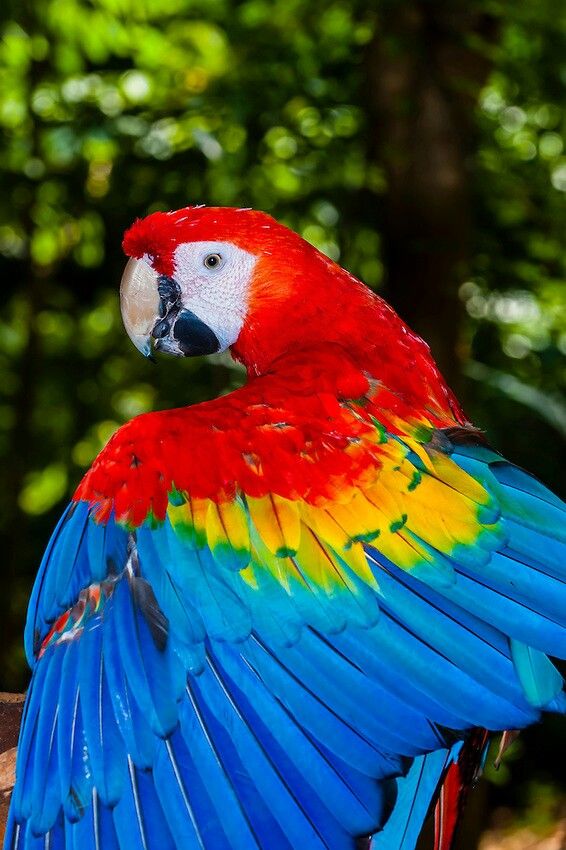
In the tropical lowlands of Central and South America, the brilliant Scarlet Macaw (Ara macao) is most often associated with towering rainforest trees. Yet in some regions, these dazzling parrots have adapted to an unusual home: the weathered limestone cliffs, pocked with countless circular holes.


Over centuries, rain and wind have carved the limestone into honeycombed walls, creating natural cavities that mimic tree hollows. For macaws, these openings provide safe and elevated nesting sites, sheltered from predators and shaded from the midday heat.
During breeding season, a bonded pair of macaws will claim one of these holes, where the female lays two to four eggs. Inside the rocky chamber, the chicks hatch blind and featherless, cared for tirelessly by both parents. The adults shuttle back and forth, bringing fruit, nuts, and seeds from the forest. Slowly, the nestlings grow into the bold red, yellow, and blue plumage that will one day light up the sky.
These limestone walls, however, are not exclusive to macaws. Bats, swifts, and even insects may compete for the same spaces. Finding a secure hole is a challenge, but once established, the macaws defend their nest fiercely, their harsh calls echoing against the stone.


To see a scarlet macaw chick peeking from a limestone hole is to witness the species’ resilience and adaptability. Whether in the heart of a rainforest or in the rugged face of a cliff, the macaw transforms a simple cavity into a cradle of survival.