
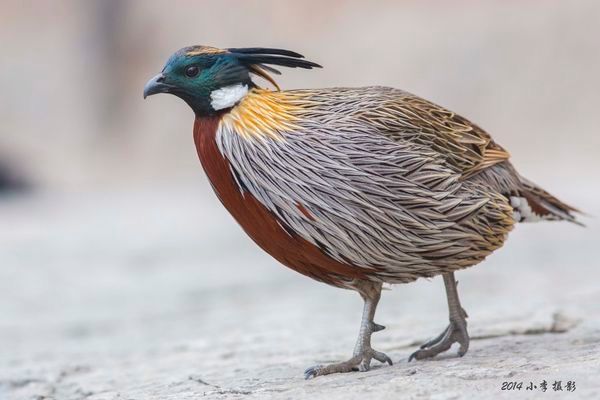
The Koklass Pheasant (Pucrasia macrolopha) is one of the most elusive and elegant gamebirds of Asia’s highlands, quietly inhabiting the temperate forests stretching from the Himalayas and Hindu Kush to western China. Unlike its more flamboyant pheasant relatives, the Koklass prefers subtle beauty — long-tailed, slender, and cloaked in earthy browns, mossy greens, and streaks of bronze that blend perfectly with the misty understory of mountain pines and rhododendrons.
Despite being called a pheasant, this species behaves more like a forest grouse. It rarely struts in open fields; instead, it slips through shadows, flying swiftly between trees when disturbed. Males are striking in their own understated way — marked by a glossy green head, a white collar, and two elegant black ear tufts that flare when displaying to females. Their haunting, echoing call — “kok-kok-kok” — is what gives the bird its name, often heard at dawn through the misty valleys it calls home.


Koklass Pheasants are found at elevations between 1,800 and 3,600 meters, moving seasonally up and down the slopes in search of food. They feed on a mix of roots, berries, seeds, and insects, scratching through leaf litter much like chickens in the wild. In winter, they often descend to lower altitudes, sometimes approaching remote villages at the forest edge.
Their secretive nature has helped them survive centuries of hunting pressure, but habitat loss and deforestation continue to threaten local populations. In some parts of their range, forest fragmentation isolates groups, limiting their breeding success. Fortunately, the species as a whole remains classified as Least Concern by the IUCN — a testament to its wide range and adaptability.
To those who have seen it, the Koklass Pheasant embodies the quiet resilience of the Himalayas — a bird that thrives not through brilliance or display, but through harmony with its rugged, mist-draped world. In the hush of mountain dawn, when its call rises through the cold air, it feels less like a cry and more like the heartbeat of the forest itself.