
The Meves’s Starling (Lamprotornis mevesii) is a sleek, shimmering songbird of southern Africa’s dry woodlands and mopane savannas, ranging across Namibia, Botswana, Zimbabwe, Zambia, and northern South Africa. Named after the 19th-century German ornithologist Wilhelm Meves, this bird is both elegant and adaptable — a familiar companion of the open bush where acacia and mopane trees dot the landscape.
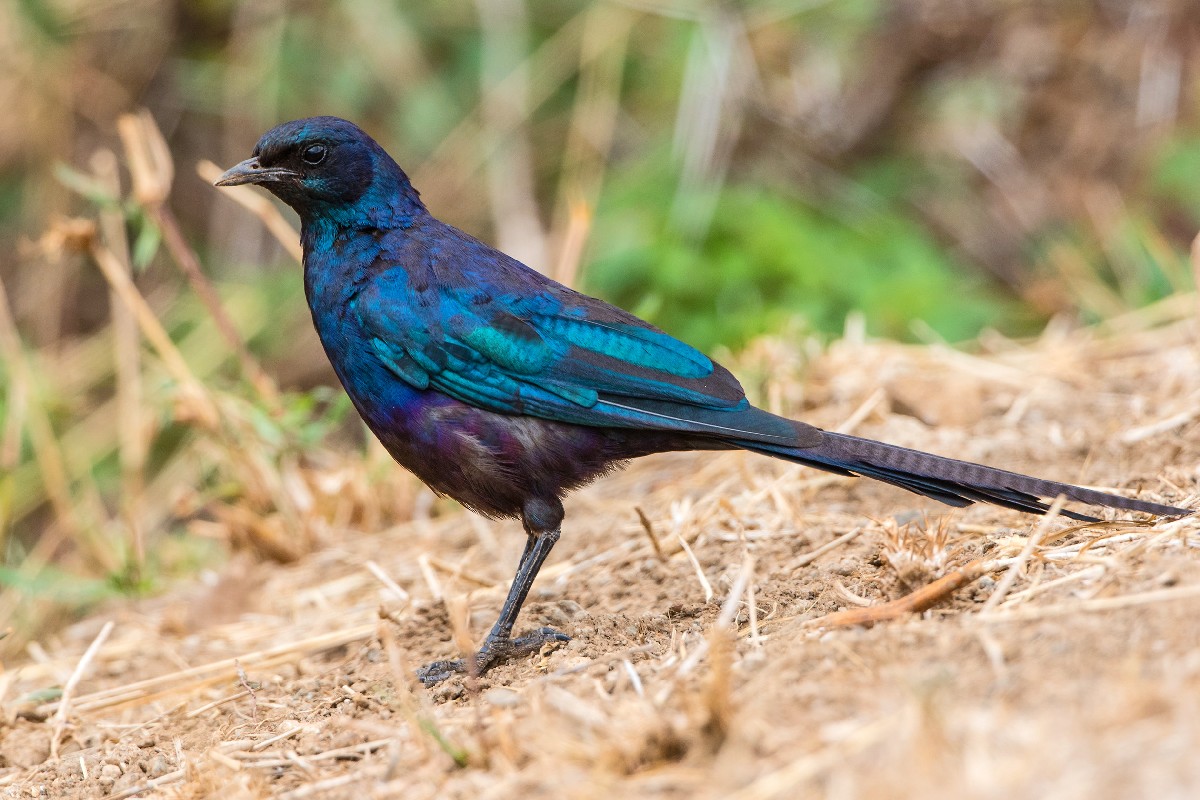
At first light, its plumage comes alive. The entire body glows with metallic blue-green and violet hues, an optical illusion created not by pigments but by microscopic feather structures that refract sunlight. In shade, the bird appears charcoal-black; in sun, it turns into liquid sapphire. Males and females look almost identical, both exuding that polished brilliance typical of the Lamprotornis starlings.


Highly social and intelligent, Meves’s Starlings are often seen foraging in small flocks, walking briskly on the ground or flipping leaves to uncover insects, spiders, and small fruit. They also form mixed feeding groups with hornbills, rollers, and drongos, exploiting disturbances caused by larger animals. Their calls — a rich mix of whistles, trills, and metallic notes — ripple through the bush, serving both as communication and as a kind of territorial chorus at dawn.
Breeding season, which coincides with the rains, brings bursts of activity. The species nests in tree cavities, often reusing old woodpecker holes or natural hollows. Both parents share incubation and chick-rearing duties, defending their nest fiercely against snakes and monitor lizards. Outside the breeding period, they roost communally, sometimes in flocks of hundreds, filling the evening sky with flickers of blue light.
Unlike many of their forest-dwelling relatives, Meves’s Starlings have adapted well to human presence and even thrive near villages and farms, provided that tall trees remain for nesting. For now, they are listed as Least Concern by the IUCN — a testament to their resilience and ecological flexibility.
Still, their survival depends on the health of Africa’s mopane woodlands, ecosystems that face increasing pressure from logging, overgrazing, and shifting climate patterns. The Meves’s Starling remains a symbol of that balance — a bird that turns sunlight into song, and the arid bush into a living, iridescent stage.