
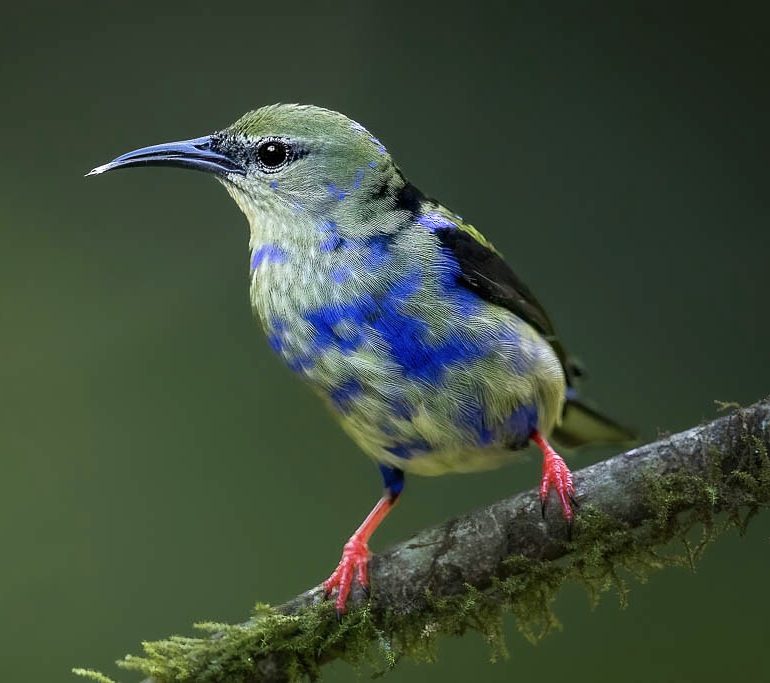
The Red-legged Honeycreeper (Cyanerpes cyaneus) is one of the tropics’ most dazzling songbirds, a living jewel of Central and South America. The breeding male glows with electric-blue plumage, a velvet-black mask, turquoise crown, and bright red legs, while females and juveniles wear softer green tones for camouflage.


These birds are found in lowland forests, plantations, and gardens, often flitting restlessly in small flocks. With their curved bills, they sip nectar from flowers, but they also feed on fruit and insects, making them important pollinators and seed dispersers in their ecosystems.
Males are highly active, frequently performing rapid wing-flicks and hopping displays to attract females. Their red legs are not just decoration — they flash vividly during courtship, acting as signals of health and vitality.
Red-legged Honeycreepers are generally common, but local populations can decline due to deforestation and habitat conversion. Fortunately, their adaptability allows them to thrive in secondary growth and even near villages, where flowering plants provide food.


For birdwatchers, seeing one in full sunlight is unforgettable — a sapphire-and-ruby vision, small yet impossibly radiant, like a tropical gemstone come to life.