

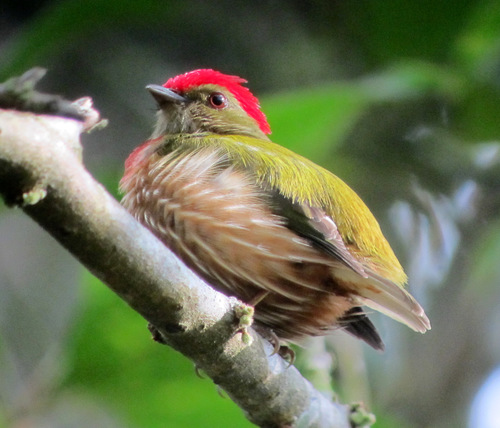
The Striolated Manakin (Machaeropterus striolatus) is a small, secretive bird of South America’s rainforests, best known for the males’ elaborate courtship dances. At just 9–10 cm long, it may look modest with its olive-green back and finely streaked underparts, but when displaying, it becomes a performer of extraordinary precision.


Males gather at traditional display sites called leks, where each bird clears a patch of forest floor or low perch. There, they perform rapid hops, short flights, and wing-snaps, all while producing sharp calls to catch the female’s attention. The choreography is so exact that females can judge the skill — and fitness — of each suitor.
Unlike the showy plumage of other manakins, the Striolated Manakin’s beauty lies in its subtle markings: thin streaks across the breast and belly that shimmer in dappled light. This cryptic look helps it stay hidden when not displaying, as it forages quietly on small fruits and insects in the midstory of the forest.
The species is found across the Amazon Basin, from Colombia and Ecuador to Peru, Brazil, and Bolivia. Despite its small size, its role as a seed disperser makes it important for rainforest regeneration.


Still common in many regions, the Striolated Manakin faces the same long-term threats as much of the Amazon: deforestation and habitat fragmentation. Protecting intact forest is key to preserving not only this tiny dancer, but also the complex ecological stage it performs on.