
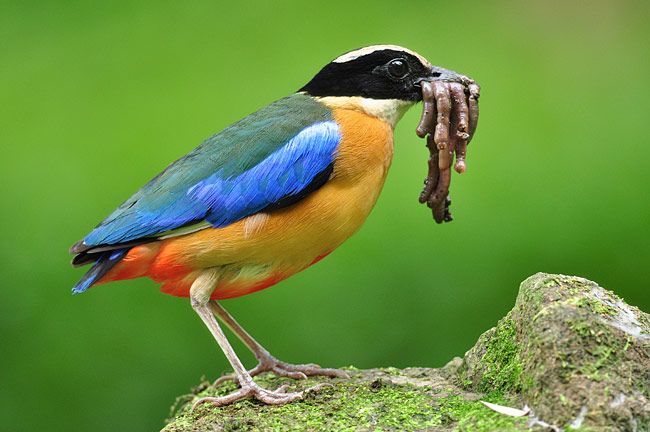
In the dense, humid forests of South and Southeast Asia, the Hooded Pitta (Pitta sordida)—with its velvety black head, emerald-green body, and crimson belly—lives much of its life hidden among shadows. But during the breeding season, these shy birds reveal one of their most remarkable sides: their devotion as parents.


Hooded Pittas build their nests close to the ground, usually a dome-shaped structure of leaves, twigs, and moss, tucked under shrubs or among roots where it is well-camouflaged. Once the female lays her clutch of three to five eggs, both parents share incubation duties, quietly switching shifts so that the eggs are never left unattended.
When the chicks hatch, blind and featherless, the parents’ work intensifies. They tirelessly hunt for insects, beetles, earthworms, and small invertebrates, stuffing their beaks full before hurrying back to the nest. With soft calls, they deliver food to the gaping mouths, sometimes feeding each chick in turn to make sure no one is left behind.
As the young pittas grow, pinfeathers sprouting through their bare skin, their parents continue to watch over them. Any disturbance near the nest is met with loud, sharp alarm calls and distraction displays—flashing their colors to lure predators away.


By the time the chicks are ready to fledge, their feathers are strong enough to mimic the adults’ striking green plumage, though their colors are slightly duller. Even after leaving the nest, they continue to beg for food, fluttering their wings and calling until their parents oblige.
This careful and patient parenting is essential, for life on the forest floor is full of dangers. Yet thanks to the vigilance of their mother and father, many Hooded Pitta chicks survive their first fragile weeks, eventually disappearing into the forest understory as independent birds.