
On the icy shores of South Georgia, where tens of thousands of king penguins gather in a restless sea of black, white, and orange, one bird stood apart—so radiant, so unreal, it looked as though it had been painted by sunlight itself.
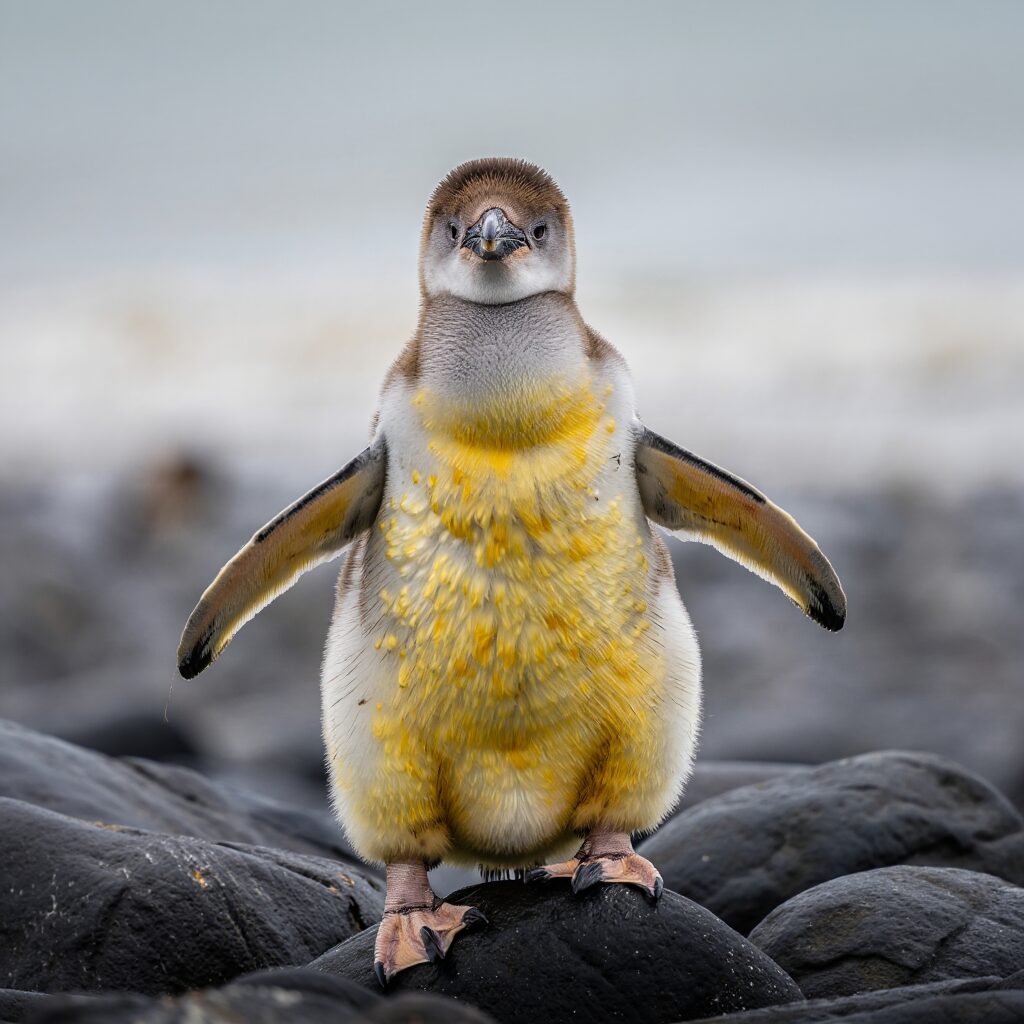
In 2019, wildlife photographer Yves Adams captured what most of us would never believe without proof: a golden king penguin, its feathers glowing in shades of lemon and honey, gleaming like a torch among 120,000 identical neighbors.


This bird owes its splendor not to costume or trick of the light, but to leucism—a rare genetic mutation. Unlike albinism, which erases all pigments, leucism blocks only melanin, the pigment responsible for dark coloration. The penguin’s blacks vanished, but its golden pigments, derived from spheniscin, remained untouched. The result? A creature that looks less like a bird and more like a myth.
But such beauty carries weight. In the wild, penguin plumage is more than decoration—it’s survival. Dark backs camouflage them from predators above, while white bellies hide them from hunters below the sea. Alter that pattern, and the balance shifts. To stand out is to risk being seen.
Yet this golden wanderer made it to adulthood, strong enough to cross oceans and stand among its kind. Perhaps its coloring hinders it. Perhaps it charms. Some scientists wonder whether the dazzling gold could even give it an advantage in courtship—a living jewel no mate could ignore.


Whatever its fate, the golden king penguin remains a reminder of nature’s unpredictability: even in the most uniform colonies, evolution sometimes writes a one-of-a-kind masterpiece. The odds are astronomical—1 in 30,000 by some estimates—but against those odds, one bird gleamed like sunrise on ice, and the world saw what should have been impossible.