
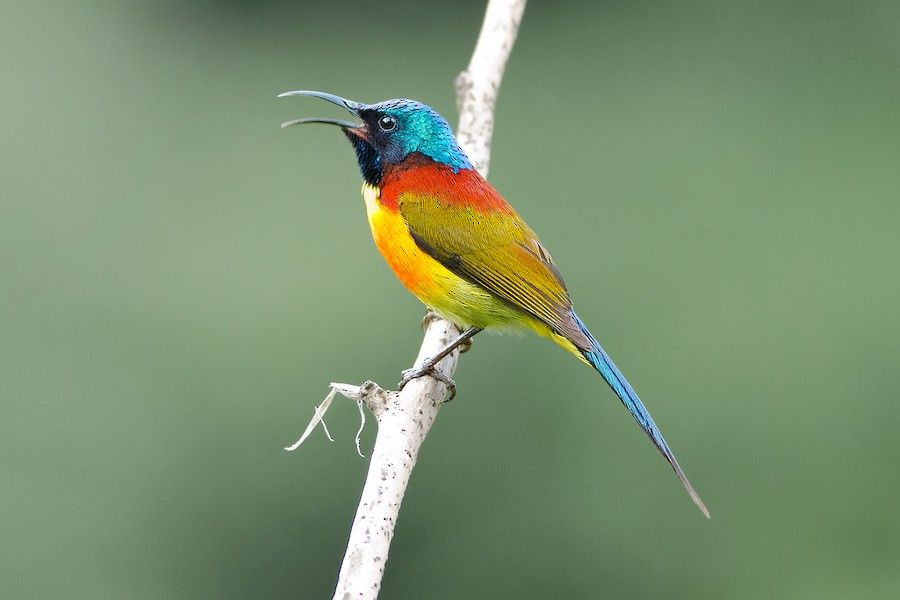
Few birds capture sunlight like the Green-tailed Sunbird (Aethopyga nipalensis). Males sparkle with a dazzling mix of metallic green head, fiery orange breast, deep purple-blue wings, and of course, a glittering emerald tail. Females, though more subdued in yellow and olive, carry a subtle elegance that blends perfectly with the forest canopy.


These tiny nectar-feeders are the hummingbirds of the Old World — darting quickly from flower to flower in the Himalayan foothills and montane forests of South and Southeast Asia. Their long, curved bills are perfectly adapted for sipping nectar, though they also snap up insects to fuel their high-energy lifestyle.
What makes them remarkable is their altitudinal migration. In summer, they thrive in the cool air of rhododendron forests at 2,000–3,000 meters. But as winter grips the mountains, they descend to lower valleys, following blooming plants in search of nectar.


Males put on spectacular courtship displays, perching where their iridescent feathers catch the sun, shimmering like living gemstones. Their song is a mix of thin whistles and twitters — not powerful, but bright and cheerful, echoing in the crisp mountain air.
From Nepal and Bhutan to northern Vietnam and Thailand, the Green-tailed Sunbird is a living emblem of highland beauty — proof that even in the thin, chilly air of the Himalayas, nature finds a way to dazzle.