
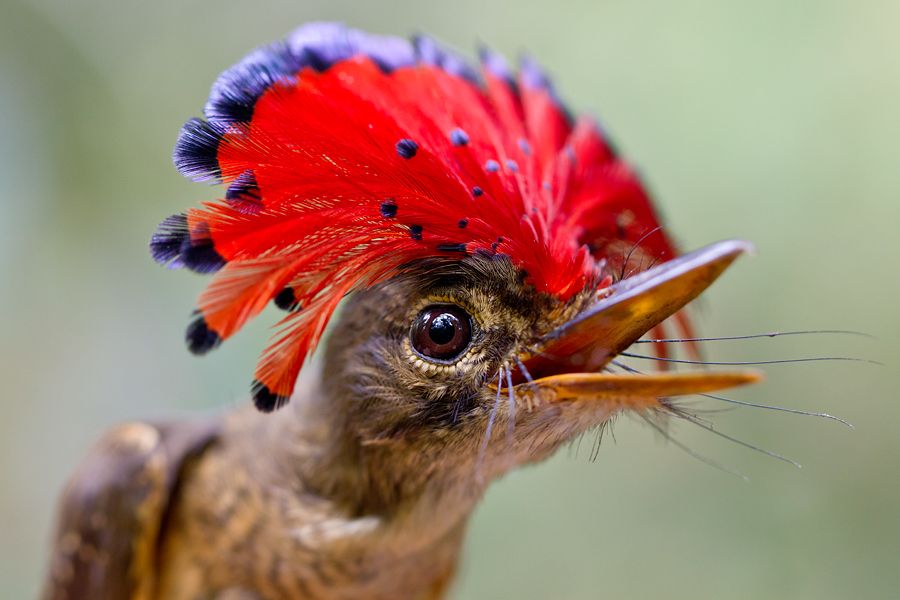
The Atlantic Royal Flycatcher (Onychorhynchus swainsoni) is a small insect-eating bird of Brazil’s Atlantic Forest, famous for possessing one of the most spectacular — yet rarely seen — crests in the avian world. When relaxed, the crest lies flat and almost invisible; but when raised during courtship or excitement, it forms a brilliant fan of red, orange, and blue feathers, like a tiny sunburst.
What makes this display even more remarkable is that both males and females possess it, though males’ crests are brighter. The crest’s sudden flare serves as a signal in courtship and territorial defense, possibly evolved to surprise rivals or impress mates in the dim forest understory.
The Atlantic Royal Flycatcher belongs to a genus spread across Central and South America, but its Atlantic Forest population is genetically distinct and likely the most endangered. Due to severe habitat loss, this subspecies is now confined to a few forest fragments in eastern Brazil.


Its behavior, however, is as refined as its looks: it perches quietly on low branches, darting out to snatch insects midair before returning to the same spot — a typical flycatching pattern. Its nest is another wonder: a long, hanging structure of moss and fibers, sometimes over a meter in length, suspended above water to deter predators.
Although modest in voice and color most of the time, when it unfurls that fiery crown, the Atlantic Royal Flycatcher reminds us that even the quietest corners of the forest can hold moments of pure brilliance