
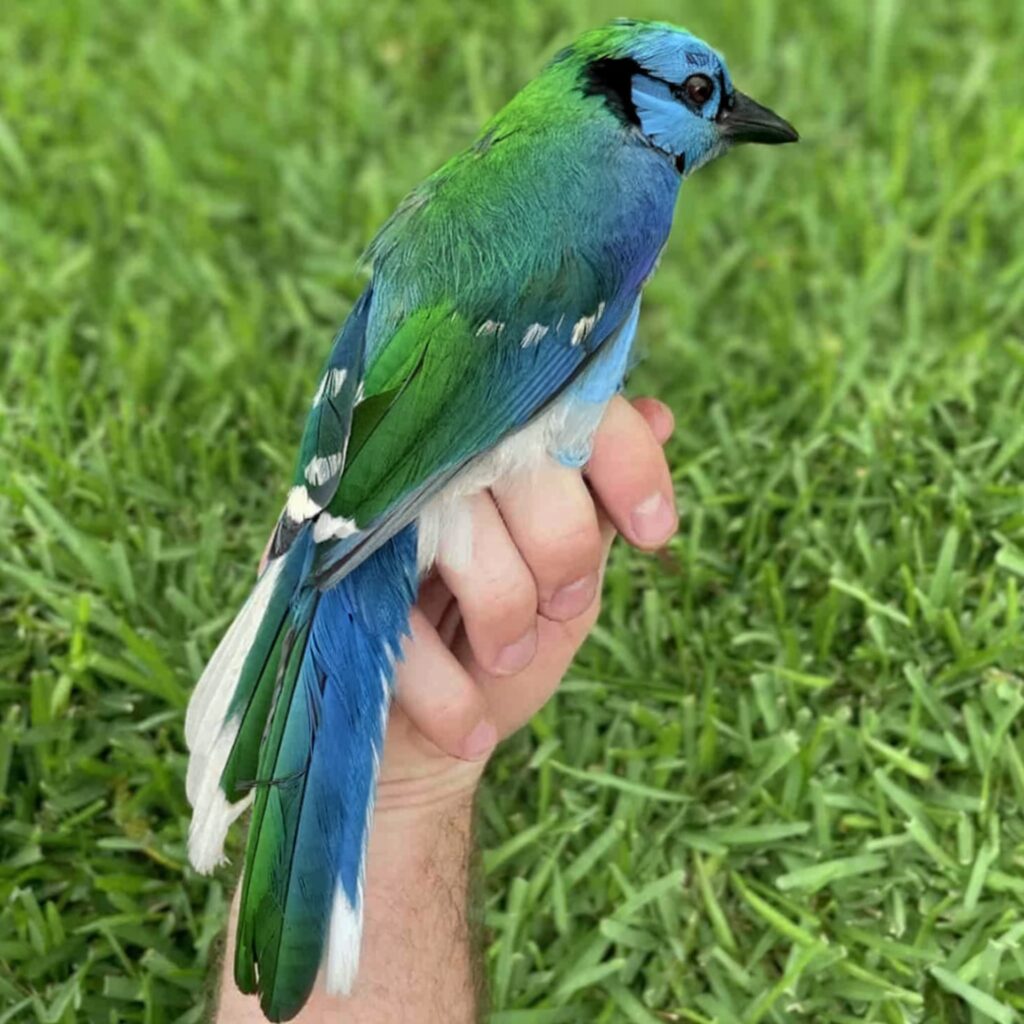
When a striking jay with sapphire and emerald hues began visiting a backyard in suburban Texas, scientists were puzzled. With the bold plumage of a Blue Jay and the slender frame of a Green Jay, it seemed to belong to no known species. After genetic tests, it was confirmed: this was the first known wild hybrid between those two species — the “Grue Jay.”
This unusual bird is not just a cosmetic oddity. It represents a rare crossing of two species that until recently occupied largely separate ranges: the Blue Jay, dominant in temperate eastern forests, and the Green Jay, a resident of Central American and southern Texas woodlands. But as climate shifts push both species’ territories outward, their ranges now overlap — offering new opportunities for interbreeding.
The backyard that first hosted the jay became a field lab: researchers caught it, took a blood sample, banded it, and let it go, later confirming via DNA that its mother was a Green Jay and its father a Blue Jay. Over time, the bird faded from view — until June 2025, when it reappeared, returning to the same yard where it was first spotted.
Scientists view this hybrid as more than a curiosity. It may be one of the first examples of vertebrate hybridization directly linked to climate-driven range shifts. As rising temperatures and habitat changes push species into new territories, previously separate populations can come into contact — and cross.
This discovery echoes a broader truth: the natural world is more fluid than we often assume. Species boundaries that once seemed fixed can blur when environments change. The Grue Jay stands as a living testament to nature’s capacity for surprise — and a reminder that climate change may stir not just extinction, but also unexpected evolutionary twist.