
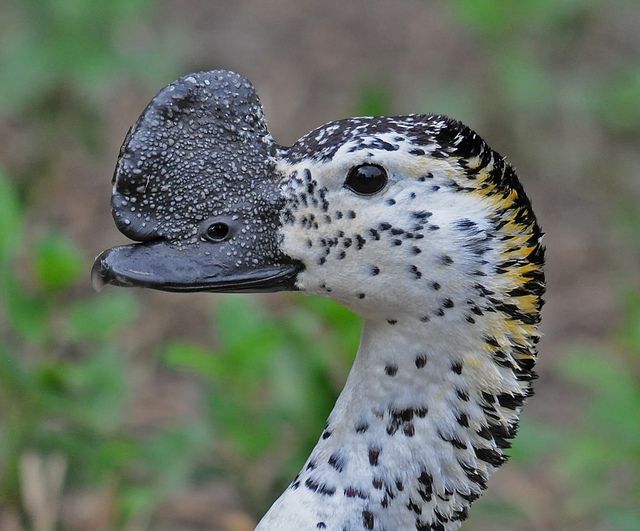
The Comb Duck (Sarkidiornis melanotos) is one of the world’s most unusual ducks, instantly recognizable by the bulbous black “comb” on the male’s bill. This odd, helmet-like growth becomes especially prominent during the breeding season, when males display aggressively to rivals and try to impress females.


Distributed across tropical wetlands of Africa, South Asia, and South America, Comb Ducks are among the largest perching ducks, often perching high in trees despite their heavy build. They are powerful fliers, sometimes traveling long distances between lakes, swamps, and flooded fields.
Their plumage is equally striking: males shine with iridescent green, blue, and purple on their wings and back, contrasting with a pure white head spattered with black spots. Females are smaller and lack the bill comb, but share the same spotted patterning.
Feeding mainly on seeds, grasses, aquatic plants, and small invertebrates, Comb Ducks forage in shallow waters or graze on land. Unlike many ducks, they nest in tree cavities or hollow logs, sometimes reusing old nests of other large birds.


While not globally endangered, they face localized declines due to wetland destruction and hunting. Their strange appearance and tree-perching habits make them one of the most fascinating and unexpected members of the duck family.
The Comb Duck proves that in nature, even the oddest adaptations — like a giant helmet on a bill — can become a badge of strength and survival.